

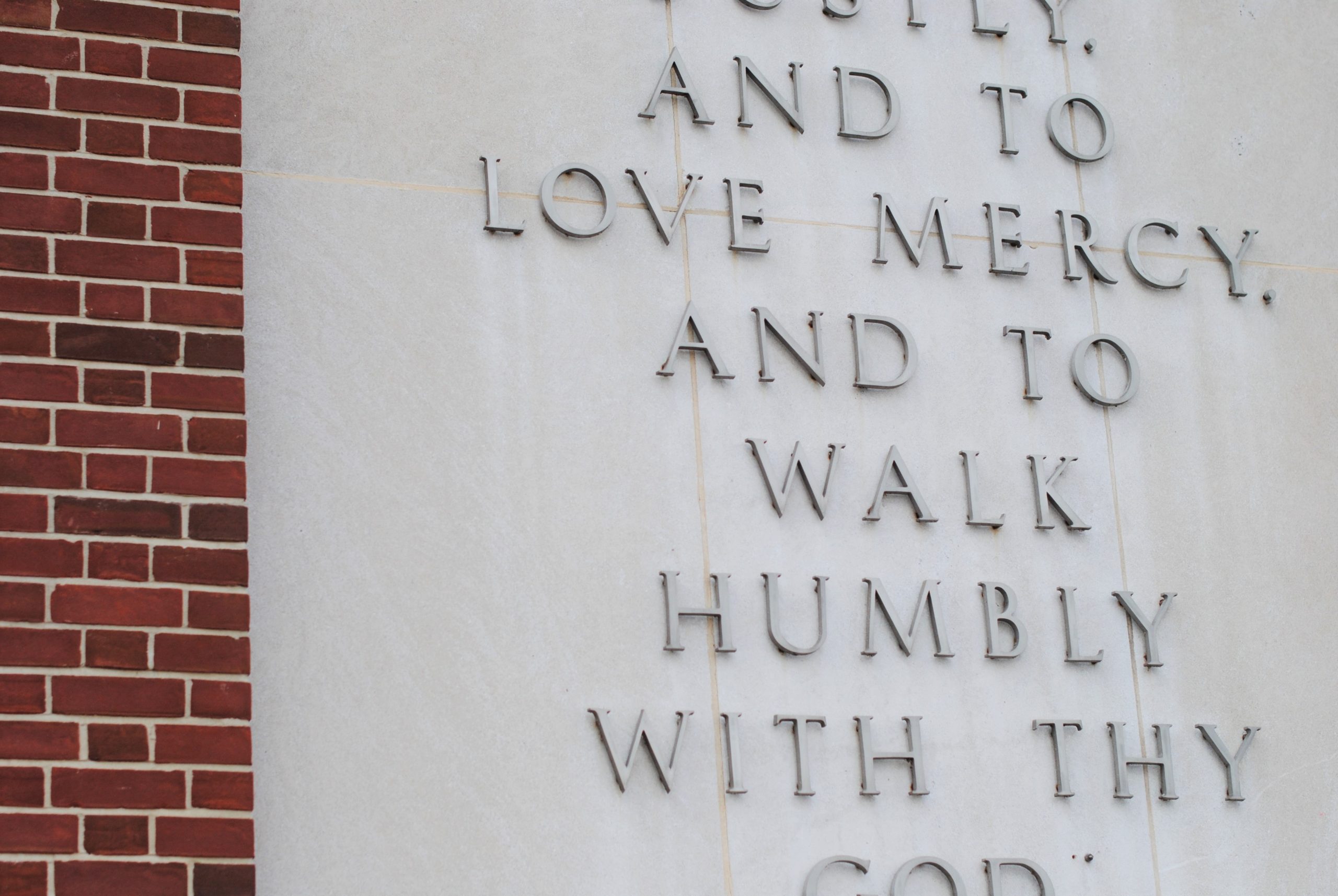
The Just God?
I really love the Message’s translation of Psalm 130:3-4: “If you, God, kept records of wrongdoings, who would stand a chance? As it turns out, forgiveness is your habit, and that’s why you’re worshiped.” Isn’t this a lovely way of putting it? Particularly the last part that states “forgiveness is your habit.” What this psalm is implying is that it is because of God’s mercy and grace poured out on us that we revere him. We can’t help but worship and adore him when we realize that no matter what we do, he will never abandon us or stop offering us his grace.
This portion of Psalm 130 reminded me of my favorite book by C.S. Lewis, Till We Have Faces. The novel is a re-telling of the Greek myth of Psyche and Eros, and it follows the life of Orual, sister of the beautiful Psyche. The novel is set up as Orual’s accusation against the gods (who stand-in for God in this text), and all of it is written to expose what Orual believes to be the horrible cruelty and injustice of the gods whom she has always believed were responsible for her suffering.
The story culminates when Orual recounts a vision of the afterlife shortly before her death. In this vision, Orual’s world is utterly shattered. She is horrified to discover that all of the pain and cruelty she ascribed to the gods was actually pain and cruelty brought about by her selfishness and her disordered love for those around her. It is a heart-wrenching moment since from the very beginning of the novel Lewis masterfully causes you to identify with all of the things Orual feels and does, only to discover (with her!) that all of the people she loved most in the world were hurt and destroyed, not by the gods, but by her. By the time she realizes all this, though, it’s too late to go back and change anything. Her life is almost at its end.
At this point, Orual is completely demoralized by her own brokenness. In despair, she says to her old tutor, the Fox (who is with her in her vision of the afterlife):
ORUAL: I cannot hope for mercy.
THE FOX: Infinite hopes–and fears–may both be yours. Be sure that, whatever else you may get, you will not get justice.
ORUAL: Are the gods not just?
THE FOX: Oh, no, child. What would become of us if they were?


Just You Wait
As this psalmist puts pen to paper and creates the eighth song in our Road Trip Playlist, he sets his sights on the LORD’s faithful love and abundant redemption, and what he’s calling on the people of God to remember is that the LORD is the One who will redeem them from all their sins. They will not have to pay the ultimate price for their disobedience and rebellion because God has freely chosen to intervene and “pick up the check,” if you will. This is an amazing reality they are told to hope for or to wait for because they are on their way to Jerusalem to offer sacrifices for their sins. Once they hear the “word of forgiveness” connected with the sacrifices they’ve offered, the “will redeem” becomes “has redeemed” (at least for another year until they repeat the process). As they make their way to Jerusalem, they reflect on their sinfulness and how much they need to hear, and even longer to hear, that their iniquities have been forgiven. This is what they hope for, and wait for, “in the LORD.” This is the main idea of these verses.
There is, however, another angle to redemption I want to explore for a minute and it is the LORD’s ability to redeem by offsetting the bad effects of the sins we commit. We know we are disciplined by the LORD when we sin (Hebrews 12:6), we know we aren’t always freed from reaping what we sow (Galatians 6:7) and from dealing with the consequences of our choices. But the LORD has this faithful love for us which moves Him to do even more than the amazing “more” He’s already done!
At the moment our heart receives God’s forgiveness and grace, at the time our soul realizes we won’t have to pay for our sins because of Christ’s sacrifice, there is abundant joy. But sometimes a lingering sadness accompanies that joy because we look around and realize the damage we have done - to ourselves, to those we love, sometimes even to total strangers. And that bums us out. We are very grateful for full forgiveness, and we worship God because of it, but we wonder if anything good could possibly come out of the mess we’ve made of things.
It’s here that this other aspect of redemption comes in. In His redeeming work, not only does God buy us back and make us His again, but He also starts a process of redeeming the sinful choices we make. I don’t know how He does it, but He works things out whereby He actually brings good from our bad, and He lets us experience it! (This is, of course, not an excuse to do more bad so that He can bring about more good! See Romans 6:1.) Maybe this is a part of the “grace upon grace” that John talks about in John 1:16?
What I’d like to encourage you with today are these two unbelievable realities - first, you have been saved by grace through faith in Christ, and in that, you have been redeemed from the penalty of sin. Second, the God who saved you also wants to redeem the circumstances your sins have created or may create. He can bring beauty from ashes, amazing futures from destructive pasts, kingdom usefulness from kingdom rebellion. Don’t believe me? Just you wait!
Scott Smith
Connections and Growth Pastor


The Patient God
I can recall my first day of skiing. My youth pastor had taken me down various intermediate slopes all day long, teaching me how to turn and stop. At the end of the day, he promised to take me down a black diamond. I carefully weaved my way back and forth across the slope at a slow speed. About halfway down, I was bored, so I started asking if I could just go for it? After my fourth or so plea for adventure, he finally acquiesced. I bolted straight down the hill and much to my own chagrin soon realized that this was not going to end well. I decided to use my recently learned stop tactic and made a hard right, back up the hill, hoping that my momentum would be slowed. As a large tree appeared directly in front of me, I thought to myself, “Perfect, I’ll just reach out and grab it!” That, too, didn’t end the way I had anticipated - but I certainly did come to a screeching stop!
Oftentimes I think about how God is teaching me patience; a lesson of which I’m not very fond! Lesson after lesson of learning to wait on Him and trust His perfect timing. I feel like I am constantly being taught patience, but what about God being patient with us? We focus on verses like James 1:17 which says, “Every good gift and every perfect gift is from above, coming down from the Father of lights, with whom there is no variation or shadow due to change.” Indeed! God longs to pour blessings upon his children; but have you ever stopped to think that maybe those blessings could be even more beautiful and powerful if they were received by children fully and completely relinquished to their Lord?
The first three verses of Psalm 130 talks about a people crying out to God from the depths of their souls, asking for forgiveness and deliverance. Verse 4 affirms the fact that God does forgive! But then in verses 5 and 6, we return to waiting. God has already declared his forgiveness so why must those who desire to follow him wait? Or are we the ones who are really doing the waiting? Could it be that God knows our souls better than we know ourselves? Like a new skier who thinks she is ready to fly, could it be that God is patiently waiting and saying, “Trust me, you’re just not ready”?
I’ve often found that after confessing sin, God doesn’t respond as quickly as I would hope. It’s not a matter of him not instantly forgiving, in fact, he forgave long before I even asked. As we read in James, God longs to bless his children. So could it be that the waiting that we experience is a demonstration of God’s own patience? It is a picture of a loving Father, longing to pour out his blessings, yet knowing that in order for us to receive what we can’t even fathom, we must be fully relinquished to the will and way of our loving and patient God.
Lynette Fuson
Director of Care & Counseling

A Forgetful God
If you, LORD, kept a record of sins,
Lord, who could stand?
4 But with you there is forgiveness,
so that we can, with reverence, serve you. Ps. 130 3-4
How can our amazing God who is all unknowing, and present everywhere be forgetful? In this Psalm we are reminded (in case we forgot) that God chooses to keep no record of our sins and his very character does not allow him to remember our wrongs. When God forgives, God forgets. That is the miracle of God’s loving character. Psalm 103:12 tells us that God has removed our sin from us as far as the east is from the west. He erased it from the pages of time.
In Jeremiah 31:34, God says, "I ... will remember [your] sins no more." God has pushed the delete button on our guilt. That same godly love in us allows us to forgive others for past wrongs, abuse, and injustice, even though it might be difficult at times. How easy it is for my mind to go back in time and remember a past offense when at the moment the same thing is happening again. Yet that is never the case with God where we are concerned. And the psalmist says, if you, Lord, kept a running tally of all my wrongdoings, I’d have no chance. But our God is always forgiving and always giving us more chances. That doesn’t mean that he relieves me of all consequences of my sin or wrongdoing, but it means at the moment I confess and repent, the slate is clean again. He also gives strength to endure the consequences and works them out for good.
Without God’s forgiveness, we would be sunk, wouldn’t we? Just like when we know God has forgiven us, but we don’t fully forgive ourselves. We’re stuck because we don’t fully trust that the slate is wiped clean, or we somehow feel undeserving. I want you to know that God created you and loves you just as you are. Romans 8:1 reminds us that there is now no condemnation for those who are in Christ Jesus. His only desire is for you to trust him, know him, and love him. He knows us and knows we will make mistakes or fail to do the things we know we should. Yet, he is waiting patiently for us to admit our failings, ask his forgiveness and rely on his strength to keep us on the right path. Even more than that, it allows us to wholeheartedly worship and serve him when we know and accept that we are forgiven.
Spend just a moment thanking God for a love so great that it keeps no record of wrong and for the ultimate sacrifice Jesus paid for our sins.
Deb Hill
Executive Assistant

The Listening God
“Lord, why are you silent? Why are you always silent…?” cries Shusaku Endo in his book Silence. It’s a book detailing the story of a 17th century Catholic Jesuit who is trying to survive the shogunate persecution of the Roman Catholic Church in Japan.
The book details a twisted, heartbreaking journey of faith and doubt in which God is seemingly distant and disinterested from the very real danger of torture and death. Despite the desperate hopelessness of the book, one has to ask alongside Shusaku Endo: “Lord, why are you silent?”
God might seem like he’s silent - but perhaps it’s because He’s attentively listening.
Our human experience would suggest that God is silent. We cry out into the dark night and the empty room and the bleak season, and have no immediate response from the very pressing issues that threaten to overwhelm us. But this is not what Scripture describes God. Instead, our God heard the “groaning of the Israelites” (Ex. 6:5), he heard the prayers of Hezekiah, has said, “I have seen your tears” (2 Kings 20:5), and he “puts our tears in his bottle” (Psalm 56:8).
Even though God does not respond in the time and the place and in the way that we want Him to, he nonetheless listens attentively to our cries. And our cries are what he has most definitively responded to by giving his Son for us.
The reality is that even though God (in his mind-blowing self-control) chooses not to intervene in every tragedy and heart-break, his ultimate intervention and response on the cross does give us the confidence alongside Paul to say: "He has delivered us from such a deadly peril," namely, sin and death, "and he will deliver us again” (2 Corinthians 1:10).
While the word that we want at the moment doesn’t seem to come, the first word (the Alpha) and the last word (the Omega) have been spoken by God - and it has been definitively spoken on the cross over us!
His ultimate victory catches up with every tragedy, every circumstance, and every hardship, ultimately. Even if it doesn’t come at the moment when we are most overcome by fear, the word of God, and all that he speaks over us, is able to penetrate into the deepest and darkest night -- if we allow him to be the final word over it.
Ryan Lunde
Young Adults Pastor

Surviving or Thriving?
As we were grappling with what Psalm 129 was conveying during our writing team discussion, my thoughts kept wandering back to one of Pixar’s finest films: WALL-E.
One of my favorite scenes from this movie is the part where the ship’s captain spends most of the night finding out about what life on Earth used to be like, and he’s absolutely enchanted. The next morning, the autopilot computer tries to take control of the ship. While doing so, it tries to destroy the precious little sprout WALL-E found on Earth (which would allow them to return to Earth after being in space for hundreds of years) with the justification that they must dispose of the plant in order to survive. The ship’s captain, realizing what’s at stake now that he’s seen what life could be like, maniacally fights to save that little plant with his own justification, “I don’t just want to survive, I want to live!”
I think this mindset characterizes a believer’s possible response to one reading of this psalm; sure, the Israelites survived. They got through it. They prevailed through terrible oppression and suffering. But…is this living? Is merely prevailing in the midst of suffering and resting in God’s justice to come for the enemies you hate, truly flourishing or is it just surviving?
I think the beauty of the Gospel is that God calls us to more than just surviving; he calls us to more richness, but also, more hardship. One of my favorite ancient Greek proverbs is, “Beautiful things are difficult.” A richer life comes through tougher challenges—and yet, isn’t a life of flourishing ultimately preferable to the life of comfort and “getting by”? One verse in Romans speaks to such Christian flourishing over the “surviving” we see in this psalm:
‘If your enemy is hungry, feed him; if he is thirsty, give him something to drink…’ Do not be overcome by evil, but overcome evil with good. (Romans 12:19-21).
With the coming of Jesus, God turned the natural order of things upside down and called his followers to love those enemies who oppress them. This is the “difficult,” harder part, but I also think it’s the “beautiful” part that brings thriving.
What’s comforting is that God doesn’t call us to a life of flourishing and tells us to do it in our own strength. The Spirit is there with us every step of the way to pick us up when we fall and to give us the strength and grace we don’t have.
I like to think of loving our enemies not as something we have to do, but as something we get to do. Something that is only made possible through the love of Christ. This ability is a gift only he can give us, but one that unlocks the secret to thriving.
Ashley Carr

Justice for Scars
Psalms 129 is an interesting one, for sure. We’re looking at oppressed people who have been knocked down, but not defeated. Unsurprisingly, they’re looking for justice. They don’t just want the abuse to stop, they want their oppressors to be visited by shame, loss, and futility. They want payback.
We don’t have nations trying to separate us from our land as they did, but we find ourselves feeling knocked around pretty good all the same. I’m intrigued by the imagery in verse 3, “Plowmen have plowed my back and made their furrows long.” Obviously, this isn’t literal, but the imagery is graphic. Can you imagine the scar that would leave?
Our lives tend to leave a whole bunch of scars on us, both physical and emotional. Some are inflicted upon us by people. Some, like mine, just kind of happened. Those are tricky because there’s no person to blame or to get justice on. It just happened, sure God can use it and his grace is enough, but sometimes you just want to punch the metaphorical lights out of the thing that weighs on you for no apparent reason.
I’m reminded of such scriptures as, “Take up your cross and follow me” or, “Do not be surprised when the fiery ordeal comes upon you, as if it were something strange.” This life will have troubles, but He has overcome the world! We’re here with a mission and a purpose for a time and then we’re done. Our faith shall be sight and everything will be made new! We will receive new bodies and he will remove the mantle of suffering and replace it with robes of honor. Between you and me, I can’t wait to punt my walker out of heaven...
Jonathan Duncan

A Righteous God
People are rarely selfless.
God made us with five senses and bodily desires that need to be satisfied. Naturally, we are only aware of what our desires or our wants tell us to do. And while one can hope that as we age we can become more empathetic and understanding, we start from a place of natural selfishness that makes real selflessness highly unlikely!
This is what makes God’s intervention in our lives all the more mind-blowing: He doesn’t have to save us - but He does because He’s righteous! That’s exactly what we are shown in Psalm 129.
The Psalmist describes the injustices done to Israel: “They have greatly oppressed me from my youth,” he says. Plowmen have plowed my back. They have taken advantage of me and profited off of my suffering.
Isn’t that the way the world is? As the famous quote says: the strong do what they can and the weak suffer what they must. We are all familiar with the real or feared ways in which we have been stepped on, taken advantage of, betrayed, or crushed.
And yet, the amazingly good news comes in verse 4, “But the LORD is righteous; he has cut me free from the cords of the wicked.”
Because God is righteous, or just, He is interested, able, willing to step in and help the unhelpable, the lost causes, the marginalized. God is interested in doing this, contrary to worldly expectations, purely because this is the way that He is.
He is righteous! That same righteousness, which causes his indignation to rise against sin and evil, also causes Him to save the weak, the beggars, the crushed, the underdogs, the meak, and the mild. It is because He is righteous.
This righteousness is what gives the Psalmist the confidence to be able to look squarely in the face of the wicked and say with confidence: “may they be like withered grass, may they come to nothing, may they be turned back in shame.”
For God resists the proud but gives grace to the humble.
Ryan Lunde
Young Adults Pastor
Living with Scars
“The plowers plowed upon my back; they made long their furrows.” Psalm 129:3
I have a scar on my leg from a burn when I was 11 or 12 years old. It is visible, sometimes kids will ask what’s that from (a three-wheeler if you must know). It has healed, but the scar or mark will remain with me. From different life events, I have some emotional scars too. Of course, no one sees those, but they are just as real as the one on my leg. They have healed and through that process, they have helped me grow and change and they remind me of how I need God during times of hurt or suffering that can cut and leave a scar.
Maybe you have some scars as well, visible or not. The Jewish pilgrims had some scars, their heritage had left some from generations past. On their journey walked by groups or areas they had fought against in years past, had tension with, or even served under that had caused scars internally and sometimes externally.
For us today our understanding of this passage looks a little different than it did for the original audience, but I think that is why Jesus gave us a powerful reminder. John 16:33 “I have told you these things, so that in me you may have peace. In this world, you will have trouble. But take heart! I have overcome the world.” Trouble, suffering, and even scars will come, BUT we have Jesus! We hold on to Jesus' promise, his power, and his work to give us the ability to live with the scars we have.
Paul had a lot of scars! He reminds us in Romans 8:18 “For I consider that the sufferings of this present time are not worth comparing with the glory that is to be revealed to us.” Jesus gives us peace, he gives us hope, so we can live in the hope of his promise like Paul. Don’t be ashamed or afraid of the scars you have, instead take heart, Jesus is with you. Maybe you have some cuts that haven’t healed yet or some scars you're still hurting from. Let me encourage you to talk to Jesus, talk to a friend, talk to us, we are here to help.
Pastor Jeremy
Family Pastor

Singing in the Storm
“When people see me in my wheelchair and ask about my persistent smile, I always say, ‘I’ve learned to sing my way through suffering”. These words were spoken by Joni Eareckson Tada who became a quadriplegic at the age of 17 and has suffered in constant pain ever since.
While Joni indeed has demonstrated the life of a woman who sang her way through her never-ending suffering, my guess is that those songs were not all songs of joy, but rather mixed with songs of lament.
People like Joni Earekson, Corrie Ten Boom, and Dietrich Bonhoeffer are all admired for their tenacity, faith, and willingness to sing in the storm. Hundreds of saints have gone before who have been proven as faithful. What is your true heart response to these individuals? Do you ever find yourself saying, “that’s fine for them; I just don’t think I can withstand that kind of suffering?” What about that verse that says that God won’t give us more than we can handle? Not only does that verse not exist, but God actually tells us that we will suffer. We will experience trials. We will go through storms and feel deep pain. Yet in all of this, God hears our cries. 1 John 5:14 reminds us, “This is the confidence we have in approaching God: that if we ask anything according to his will, he hears us.” What a beautiful thing it is to know that God hears our cries! And with that reality, God tells us to sing.
Singing may be as James commands, to be done with joy. James 1:2 says to “consider it pure joy whenever you face trials of many kinds.” It is through trials that we learn to persevere, to mature, and to even thrive amidst life’s greatest challenges. Singing may also be done in lament. David cries out in Psalm 6:3 with, “My soul is in deep anguish. How long, Lord, how long?” Do you ever find yourself asking, “how long, oh Lord?” Theologian Walter Brueggemann says, “Worship isn’t about feeling good - it’s about telling the truth. Sometimes the truth is that life is hard, events are scary, and justice is hard to find. When we leave these realities out of our worship, we stop telling the truth. Most notably, we fail to tell the truth that God can do something about these struggles and that our suffering matters to God.”
Do you believe that your suffering matters to God? When was the last time that you sang out your anguish to him? Try adding “Praise You in This Storm” Casting Crowns - Praise You In This Storm (Official Lyric Video) by Casting Crowns to your playlist this week. Crying out in the storm may mean a song of lament or a song of joy. Either way, you too can find yourself singing in the storm.
Lynette Fuson
Director of Care & Counseling