

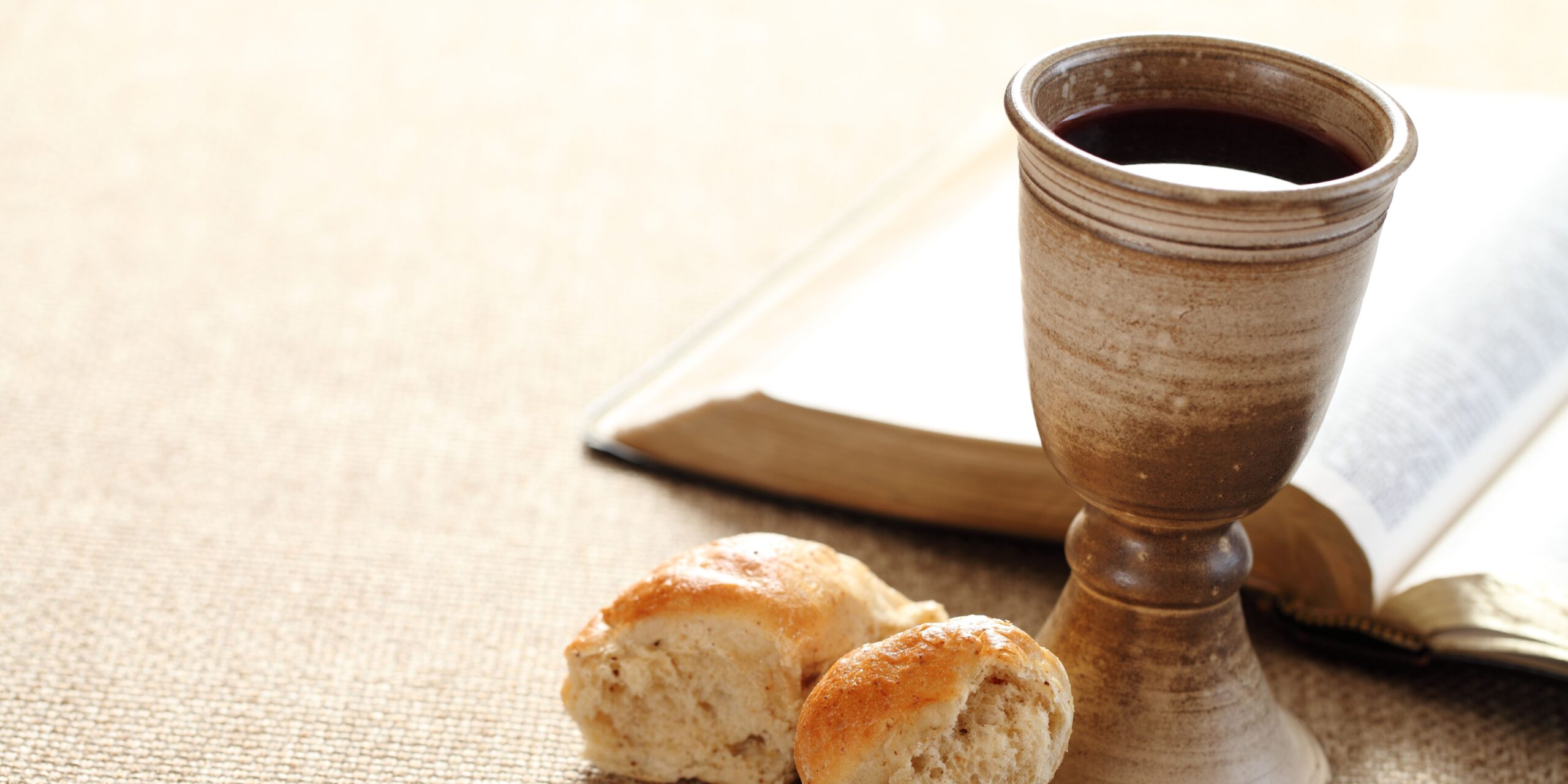
He Is Coming!
For whenever you eat this bread and drink this cup, you proclaim the Lord’s death until he comes. 1 Cor. 11:26 NIV
The Message paraphrases it this way: What you must solemnly realize is that every time you eat this bread and every time you drink this cup, you reenact in your words and actions the death of the Master. You will be drawn back to this meal again and again until the Master returns. You must never let familiarity breed contempt.
The phrase familiarity breeds contempt has always been interesting to me. Prov. 25:17 in the NIV says, “ Seldom set foot in your neighbor’s house–too much of you, and they will hate you.” (or don’t wear out your welcome I would say)
In the context of communion, I believe when it is taken with the right heart and motivation that it matters not how often, but some theologians might disagree. Some churches take communion every day or weekly, ours once a month, and some Scottish churches once a year. Some people take communion when they marry I believe to honor the Lord in their marriage and put him first as a married couple. Some people want to take communion when they know that their time on this earth is nearing an end, for reasons between them and the Lord. In each of the latter cases, I believe they are honoring God and remembering his sacrifice.
Communion unites the church family at one table symbolically to acknowledge Christ died, rose again, and will return. The most important future event will be when Christ comes back to this world. Between these two events, we declare Christ’s death to the world. When we share bread and wine at church, we are declaring the importance of Christ’s death at the same time we personally remember his blood was shed for us all.
I love that we can share communion as a church family and individually as an act of worship and honor to Jesus Christ, the Perfecter of our faith, our Lord and Savior. Personally, it causes me to examine myself and my own heart as I sit at his table and remember what he sacrificed for me. What an honor to come to the Lord’s table! What does communion mean to you? Has it become too familiar? Lord, help us to remember and declare your shed blood and sacrificed body was a substitute for our sin and has set us free.
Thank you for reading or listening today, blessings on the rest of your week.
Deb Hill


The Communion Connection
Jesus’ death connects us to him and to each other. This principle is so important that the Apostle Paul makes a stink about the saints in Corinth’s practice of communion. Actually, he doesn’t make a sink. He points out that their practice stunk.
In the following directives, I have no praise for you, for your meetings do more harm than good. In the first place, I hear that when you come together as a church, there are divisions among you, and to some extent, I believe it. No doubt there have to be differences among you to show which of you have God’s approval. So then, when you come together, it is not the Lord’s Supper you eat, for when you are eating, some of you go ahead with your own private suppers. As a result, one person remains hungry and another gets drunk. Don’t you have homes to eat and drink in? Or do you despise the church of God by humiliating those who have nothing? What shall I say to you? Shall I praise you? Certainly not in this matter!
These are the specific practices that Paul was sniffing and pointing out:
1. Not patiently waiting for some to arrive, “you go ahead with your own private suppers.”
I can relate to this. It is usually the same person or the same family that always keeps others waiting. This can be frustrating. At EFCC, we wouldn’t hold up a service or our communion, which is usually at the end of the service, because someone we were expecting to be there didn’t show up that day.
2. Some were left out, “one person remains hungry.”
Our practice of communion isn’t at lunch or dinner. I’ve often wondered what a person had to do to get seconds of communion. It is separate from our regular meals, “Don’t you have homes to eat and drink in?” We separate it today so it will be a special time of focusing on Jesus and not our stomach, not ourselves.
3. Getting drunk, “and another gets drunk.”
There has been a debate about whether the cup Jesus said was his blood was a cup of wine, a fermented drink or a cup of juice. Some argue that the bread of Passover was unfermented (without yeast) and therefore the drink would have been the same. The point is arguable and I don’t see us learning for sure until we are in Jesus’ presence. What is clear is that getting drunk takes the focus off of Jesus and is at minimum a distraction from the meaning of the Lord’s table, and probably so much worse than that and a big part of why they were doing more harm than good.
4. Not providing for those that couldn’t afford to bring food, “humiliating those who have nothing.”
“They’re late and they won’t bring anything anyway, let's just get started.” I can hear myself saying that in many modern settings. But Paul says that the church is to be connected and because of Jesus' sacrifice we care for, wait for, and honor one another. Ask God to help that be our personal and corporate practice at Emmanuel Faith. And if you notice ways that it is not, speak up and change something.
John Riley


“For You”
The Great Mercy of Christ for All and for the Individual
“For I received from the Lord what I also delivered to you, that the Lord Jesus on the night when he was betrayed took bread, and when he had given thanks, he broke it, and said, ‘This is my body, which is for you. Do this in remembrance of me.’” 1 Corinthians 11:24-25 ESV
I can’t help but be somewhat perplexed by Paul’s words on communion. He recounts the night when Jesus was betrayed as if he was there, laying out the steps of communion that we take in remembrance of the atonement made for our offenses. I have many questions that come to mind from Jesus's sayings here. For example, why bread? Why wine? What’s the significance of the physical practice of remembrance? Why not simply remind us every day of His sacrifice in our spirits? That is another question for another devotional. However, I think the deepest question I have stems from this statement: “This is my body, which is for you.”
“You” in verse 24 is actually plural. Jesus is saying that His body is for “all of you.” To expand on this in the words of John the Baptist, He is “the Lamb of God, who takes away the sin of the world.” (John 1:29 ESV) It’s clear that Christ’s life and death serve as the payment for all of humanity’s reckless disobedience and evil. I have a qualm with this idea, though, if I may be so bold. While it is true that one man died for all so that all men might have life (see Romans 5), I have had many brothers and sisters in my circle tell me that Jesus died for my sins, and not simply as one underneath a blanket covering for all, but deeply and personally given up for me as an individual. Is this possible, let alone Biblical? Does the mercy of Christ extend to both the collective body and the individual? I would argue, yes. Let’s see this from the scripture.
“And Jesus, perceiving in himself that power had gone out from him, immediately turned about in the crowd and said, ‘Who touched my garments?’” Mark 5:30 ESV
Jesus was touched by countless different people from all over the country who came to see Him. Yet there was one whom He noticed. A woman who had bled for twelve years of her life came to find Christ. She knew she could be healed just by touching His clothes. Out of everyone in the crowd, Jesus saw her, and healed her personally, responding with the historic statement, “daughter, your faith has made you well.” (Mark 5:34) The same Jesus who spoke parables to the multitudes, spoke with tenderness to the individual. The same Jesus who heals many healed this one woman out of the crowd. This is the Jesus we worship. The Messiah not only died for many but died for the individual.
“Consequently, he is able to save to the uttermost those who draw near to God through him, since he always lives to make intercession for them.” Hebrews 7:25 ESV
Not only is our Savior able to save us from our sins, but He is also able to save us to the uttermost, that is, to the fullest extent. And not only did He die but is actively advocating on our behalf before His Father. There is a catch, however. You must draw near. You must be willing to be known. You must be willing to be saved and healed to the uttermost as an individual, not just part of the group. This is what He laid down his life for; to make a way for each of us to draw near and be whole. How great is His love for us? Remember this when you eat: that not only was His body broken for the entire world, but His body sacrificed for you too. Amen.
Jared Graf


Our Present to Our Past
Do you have any moments in your life that have left a lasting memory or defined who you are? I had the joy of officiating a wedding the other day and it reminded me of one of those moments that will be a foundation for the couple to build on for the rest of their lives. A couple of weeks prior I had the chance to lead a friend’s memorial service. Another defining moment that changes the trajectory of lives. I share this because there was a night in history that changed everything. Jesus gathered with his friends and did something that was going to be foundational for all who believe.
The interesting thing about this moment in history is that it began with a reminder something bad (betrayal) was going to take place; 1 Corinthians 11:23, “...the night Jesus was betrayed.” However, Jesus was doing something beautiful; a defining moment in history. The reason the Table/Communion is a defining moment is because it is the powerful reminder of what Jesus was about to do. He symbolized the giving of his life (something not normal) with the breaking of bread and drinking of wine (normal things). That act, at that moment, allows us to stand on the historical foundation Jesus gave. Since then, believers have followed the practice and allowed the Holy Spirit to work powerfully to grow them closer to God because of what Jesus has done.
What events do you build your life on? Jesus gave us a special historical event we can build on. On the night he was betrayed, he modeled what to do. Historically his actions showed we could rely on him. Here is my encouragement for you, Jesus gave you a defining moment, think of the moment you trusted your Savior. Remember what that meant then and think about what it means now. Take some time to thank him for what he has done so you can have that moment.
Pastor Jeremy


He Learned to Cook
He didn’t know how to cook. He knew very well how to eat, but the cooking part he had no idea about. He left that to my grandma. But when they found out my grandma had cancer, she decided it was time he learned. So they shifted some furniture and the cooking tutorials began from her recliner and my grandpa in the kitchen.
My grandpa and I were very close and when he shared this story with me I had to ask the question - “why was teaching you to cook such a priority? He smiled and then shared,
“Your grandma’s wish was that we would all continue to gather as a family after she passed. She knew that Sunday coffee with your aunts and holiday meals with all the family was only going to continue if I kept the tradition going.”
So he learned to cook. And I will say he became a great cook and even grew much of his own produce in the garden. I think cooking brought back sweet memories of her and made him feel connected and close living all those years without her. My grandpa has since passed and I miss him terribly, but those traditions still continue. They have changed a bit, but the love and purpose behind them are still the same.
We read about many meals Jesus had with people. Some were feasts, some were celebrations, and some were large crowds with just fish and bread. One of the most memorable meals He had was with His disciples before His death.
Before Jesus’ death, He had a special meal with his closest twelve. He told them to keep doing this meal in remembrance of Him. Although our present-day meals are measly scraps compared to the power and significance of the Last Supper, I wonder if that is why we all feel this value and importance of gathering together at the table. Jesus gathered together at the table to spend His last bit of time with His disciples. That’s a pretty powerful statement.
Our current culture doesn’t lend itself to time around the table together too easily. It takes some master scheduling at times and it’s so easy to just let it slip away. But if we value what Jesus valued and look to Him as the example, then I would argue that maybe we should fight a little harder for sitting together around the table and sharing life. It brings us together.
1 Corinthians 11:24 says, “. . . do this in remembrance of me.” When we gather together around a table and say grace, it is a moment of remembrance and also invites His Spirit into the gathering.
With that said, let’s put our napkins in our laps and bow our heads and bless the food.
Blessings as you love and serve with great purpose.
Bonnie Nichols
Women’s Ministry Specialist


No Practice
If anyone is inclined to be contentious, we have no such practice, nor do the churches of God. (1 Corinthians 11:16)
There was a battle during my childhood that divided friends, family, and even the church — “the Cola Wars.” Coke vs. Pepsi was a genius marketing ploy that didn’t really cause fighting, but it did illustrate how a simple product created contention in society by getting people to choose a side. Coke vs. Pepsi had been a battle since the late 1800s and it gave people a reason to at least argue why one was better, why one was their favorite and why the other opinion was wrong. Maybe that was the real issue, people just like to argue and be right. Outside of soda, this happens in churches, too. Should we allow hats to be worn in the worship service? Do we use our paper Bible or digital Bible? Is it the Family Center or the Gym? (See Scott Smith if you would like an answer!) Little things can cause a fight if we allow them.
Of course, this happened in Corinth and that is why we are still talking about it today. Culturally, there were practices that made sense for Romans, Greeks, Jews, Gentiles, etc., and those practices began to mesh and sometimes clash in the early church to the point people came to church with a grudge against one another (maybe someone has stolen your parking spot on a Sunday morning?). Paul knew Satan would take that foothold and rip a huge hole into the heart of the church. If they were not careful, a little contention over head coverings and prophesying grow into full-blown division. Paul gave some really simple advice I will sum up this way- make it work, we don’t have a standard practice established yet. I think 2,000 years later we still have to make things work for the sake of unity in some practices in the church right now.
Here is how I relate to this passage personally. God has done two funny things in my life that helped me “make it work.” There are two things I never thought I would be as a pastor, in charge of Resonate or Youth Ministry. But God put me in positions to let go of some of my practices and he blessed me beyond what I could ask for by allowing me to step into those ministries. My life has changed for the better because the Lord let me choose unity over contention, preference, and practice. In light of the passage and the heart of verse 16, where are some areas God might be asking you to build unity in the church? Praying for us all, hope God blesses you today.
Pastor Jeremy Johnson

Normalized Prophecy
Every church service has a rhythm, a cadence that it follows. I can remember going to a Catholic service with a friend of mine; I was completely lost. It seemed as though everyone else knew what to do — when to sit, when to stand, when to kneel. I did my best to mimic those around me, but it wasn’t a worshipful experience because I felt so lost. Protestant churches have an order of service too. It’s not quite as complicated (or maybe I’m just more familiar with it). We sing worship songs, pray, preach the Scriptures, and celebrate Communion. The early Church had an order of service too, but they included an additional element that didn’t show up in the Catholic or Protestant churches that I’ve attended.
Listen to the Apostle Paul as he writes to the church in Corinth: Every man who prays or prophesies with his head covered dishonors his head. But every woman who prays or prophesies with her head uncovered dishonors her head — it is the same as having her head shaved. (1 Corinthians 11:4-5)
Hold all those questions about head coverings for now and let’s acknowledge that Paul’s assumption was prophecy was a normal part of the worship gathering — and both men and women were participating equally in prophetic work. That word prophecy is a bit slippery, so allow me to define it. It means to foretell, as in looking to the future. But it also means to forthtell, meaning “thus saith the Lord.” Forthtelling may have looked a bit more like modern-day preaching. This was something both men and women were participating in during the worship service.
Can you imagine having a “prophecy” portion of worship? It appears the early church did. I’m not entirely sure what we ought to do with this truth, but I’m confident that we “shouldn’t despise prophecies” (1 Thessalonians 5:20). Even if it doesn’t fall directly within the public worship gathering on a Sunday morning, if we’re going to take our cues from Scripture, we must be open to prophesy, and we must position both men and women to function in the prophetic. 1 Corinthians 11 teaches us that prophecy was a normalized part of their gatherings, how might it become more of a part of our spiritual growth?
Ryan Paulson
Lead Pastor


Submission & Authority
But I want you to realize that the head of every man is Christ, and the head of the woman is man, and the head of Christ is God. (1 Corinthians 11:3)
This verse establishes an order of authority based on the trinity itself. The father is the head of the son. Obviously, the son is very much the father’s equal, they are one being in a mysterious way. Yet we have a very powerful example of Jesus humbling himself, relinquishing his godly form, and submitting in obedience to the Father's plan.
[Christ Jesus], being in very nature God, did not consider equality with God something to be used to his own advantage; rather, he made himself nothing by taking the very nature of a servant, being made in human likeness. And being found in appearance as a man, he humbled himself by becoming obedient to death — even death on a cross! (Philippians 2:6-8)
Men have Christ as their head. We choose to submit ourselves to him and try to live our lives for him instead of ourselves. I say try because our sin makes obedience really difficult, but our gracious Lord knows we struggle and he does life with us, patiently helping us follow him.
“Come to me, all you who are weary and burdened, and I will give you rest. Take my yoke upon you and learn from me, for I am gentle and humble in heart, and you will find rest for your souls. For my yoke is easy and my burden is light.” (Matthew 11:28-30)
Men are the head of women. Obviously Christ is also the ultimate head of any person, but the significance is men and women get to enter into an imperfect imitation of the communion had by the trinity itself. That is a stunningly beautiful thing, if done correctly.
There is neither Jew nor Gentile, neither slave nor free, nor is there male and female, for you are all one in Christ Jesus. (Galatians 3:28)
When a woman submits to her husband and that man submits to Christ they can weather anything and there’s a foundational order there which is a source of great peace. I, myself, am not yet married, but I've witnessed good friends carefully commit to this and they reaped such benefits, it’s really a blessing to see.
Jonathan Duncan


It's Not About US
As I began to study 1 Corinthians 11:2-16 in more depth after our writing team meeting, it became clear that even the theologians have struggled to completely understand this section of Scripture. And the ones that think they have it figured out differ from the others. It is comforting to know that I am not the only one who sometimes struggles with understanding, and we all pray for wisdom and discernment from the Holy Spirit when we write.
Pastor Esteban always reminds us of the context in which Paul was writing to the Corinthians. The church at Corinth was struggling with social mores and cultural traditions different from what was now expected of them as Christians. Professor N.T. Wright tells us, that the crucial issue for Paul was the public witness of the church. And that witness it seems was suffering in Corinth which led to Paul writing to the church regarding people wearing or not wearing head coverings, having long hair or shaving their heads, etc.
Paul wanted a very male authority-oriented and legalistic group to understand that while women should honor their husbands and in so doing, honor God, men should love their wives as Christ loved the church (Ephesians 5:25). Paul wanted women elevated from a “slave status” to one of equal importance not only as Christians but also in their culture.
Remember, the Corinthian church existed in quite a different culture and time. The main principle to me is in verses 11-12 which say, "In the Lord, however, woman is not independent of man, and man is not independent of woman. For just as woman came from man, so man comes through woman, and all things come from God." In other words, within the community of believers, the idea is that there is equal standing, and both should honor God in their relationship with each other and with their Creator.
Genesis 1:27-28 tells us that “God created man in his own image, in the image of God he created him; male and female he created them. And God blessed them.”
God created people for His own glory and purpose. We are not to be an obstacle to anyone’s faith by what we wear or what we eat or what we say. We are to do all things as unto the Lord. (Colossians 3:23)
Lord, please help us to remember that you are the Creator of all, and we are here to bring you glory and honor in all that we say and do.
Deb Hill

It’s Complicated
“A wife ought to have a symbol of authority on her head, because of the angels” (1 Corinthians 11:10). Anybody with me thinking: “Huh?”
And what about, “Does not nature itself teach you that if a man wears long hair it is a disgrace for him?” or “For a man ought not to cover his head, since he is the image and glory of God, but woman is the glory of man”? What in nature makes it obvious men should keep their hair short? And what does Paul mean by “woman is the glory of man”? Does he mean women exist to make men look good?
We know from Genesis God did form Eve from Adam’s body, but Genesis also states, “God created man in his own image… male and female he created them” (Genesis 1:27), which makes it clear God created both man and woman in his image. Furthermore, Paul himself says in verses 11 and 12, “Nevertheless, in the Lord woman is not independent of man nor man of woman.” This passage equalizes men and women by saying men need women, and vice versa. Paul reinforces this point by adding an allusion to Genesis: “woman was made from man.” He then clarifies any attempt for either party to gloat by concluding with “so man is now born of woman.”
Paul seems to be wrapping up by showing us how both men and women have important, equal roles to play in each other’s lives and in God’s kingdom. He even goes on to say, “If anyone is inclined to be contentious, we have no such practice, nor do the churches of God.” Paul seems to be encouraging the Corinthians –- if these issues about a woman’s role and conduct in church continue to be a point of friction in the church body –- to consider forgetting about the whole thing. Dismiss the head coverings as a non-issue, since friction is not worth the cost of reaching "the right answer."
But then, what about “the head of every man is Christ, the head of a wife is her husband, and the head of Christ is God”? Does this mean wives access Jesus through their husbands? And does this mean Christ is subject to the Father, in some sense? Does even the Trinity have a hierarchy, and does this imply the Father and Son are not equals? If they are equal, why is one called the "head"? (The "head" imagery can make for problematic symbolism. A foot and a head are necessary for a human to function fully, but a body can function without a foot. However, there’s not a body anywhere that can function without a head. Doesn’t that make a head more important than a foot?)
Despite dropping you into the exegetical quicksand of Chapter 11, I hope what this toe-dip has presented (since I can add much more!) is just how difficult this passage is. For almost thousands of years now, we have yet to make heads or tails of it, much less have any consistent consensus about what it says. Let’s not get so caught up in the trees with the right and wrong of how to read this passage, that we miss the beauty of the forest Paul is trying to help us see.
Ashley Carr
High School Teacher
