


Training for Growth
All Scripture is breathed out by God and profitable for teaching, for reproof, for correction, and for training in righteousness… - 2 Timothy 3:16
As we have seen this week, Paul tells Timothy that Scripture is breathed out by God for four distinct purposes and today we get to talk about the fourth purpose: training in righteousness. So we’re going to consider how this statement is true: “the God-breathed words of scripture are profitable for training in righteousness.” At first glance, you might think that this verse is a truism. In other words, you might think that this statement is obviously true and therefore not all that interesting. You might think, “Of course, scripture is useful or profitable for training in righteousness! What else would it be used for?”
My only response to that would be if this seems so true, why don’t more people live like it’s true. I definitely see people regularly using scripture for teaching (we do this every Sunday), often for reproof (discovering what you did wrong), and often for correction (trying to fix what you did wrong), but training? That’s something different. Training, as this word is used here, is a dedicated discipline so as to learn a new habit or trait. Training involves repetition and prolonged effort toward a goal of making the truth of scripture become second nature. If teaching is useful in making someone more knowledgeable (which is a good thing), then training is useful in making someone more virtuous (which I think is a better thing). To be virtuous is to do the right thing for the right reasons. In order to be virtuous, you have to know what the right thing is (teaching) and then practice it through a long process of reproof and correction until the right thing is the natural thing. This can take years, but when it happens you know that you are growing into a man or woman of God who is “complete, equipped for every good work.”
So, my question for you is, what do you need training in? What trait do you want to be more natural to you? Is it reading your Bible every day? Praying regularly? Is it responding in peace instead of anger? Or maybe it is stopping an activity or action that is bringing you down, like language, internet use, music, etc. Whatever it is, consider turning it into a training plan. Set a goal, make a list, find an accountability partner, and then make it costly. We do this all the time for other training plans. We know how much work it is to train for a race or to get in shape, why would we think training in righteousness would be any easier? Maybe it’s time to start training. What’s your plan going to be?
Josh Rose
Teaching Pastor


Conviction and Correction
As a parent, on many occasions I’ve heard my kids say to one another, “you’re not the boss of me…” or “don’t tell me what to do!” Let’s be honest, most of us don’t love it when people tell us what to do. Whether it’s a government getting too involved in our lives, or a spouse or child over asserting themselves – we don’t like to be bossed around. I think there are two primary reasons for that nearly universal sentiment. First, being bossed around confronts our desire for independence. We want to call the shots and determine the course of our own life. Secondly, most of us live with a low-grade suspicion of authority. We’ve seen power abused and people calling the shots doing so to their own benefit, so we’re inherently skeptical of the motives of those bossing us around.
We bring all that baggage into the way we read Scripture. We often resist the instruction given because we don’t want to be bossed around – even by God. We don’t want to be told we’re wrong, and so, at times, we gloss over the way God wants to confront us and call us to repentance. However, one of the purposes of Scripture is for God to speak to us and tell us that we’re wrong. Listen to the way Paul wrote about this in 2 Timothy 3:16. He said, “All Scripture is breathed out by God and profitable for teaching, for reproof, for correction, and for training in righteousness.” One of the reasons Scripture is useful is because it convicts (“reproof” in the ESV) us and corrects us.
The ideas of conviction and correction work in tandem; they’re two sides of the same coin. When the Scriptures convict, they call us out on the ways we’re wrong. When Scripture corrects, it shows us the way forward. Scripture calls us out in order to lead us forward. However, we must read the Bible with a sense of openness if we’re going to allow God to speak into our lives through it. We must be willing to be shown that we’re wrong, and we must be willing to change. We can read the Bible all day, but if we don’t have the right heart and an openness to God, we’ll resist His conviction and correction holding onto our independence and self-sufficiency.
As you read Scripture this week, maybe start your time with a short prayer, “God, show me where I’m off and lead me forward in your way.” That’s essentially what David prayed when he said, “Search me, O God, and know my heart! Try me and know my thoughts! And see if there be any grievous way in me, and lead me in the way everlasting!” (Psalm 139:23-24) Then, when the Spirit quickens you, pause and thank God; He’s calling you out to call you forward. After you thank Him, make a commitment to act on what He’s shown you.
Pastor Ryan Paulson
Lead Pastor


Wise for Salvation
As I sat down to write this devotional, the song that came to mind was Peter Frampton’s classic 1976 hit, “Show Me the Way.” Why? Because the song title reminds me of one of the main functions of Scripture, which is to “show me the way” to salvation (or as 2 Timothy 3:15 says, to make us “wise for salvation.”).
In John 5:39-40, we have a recorded interaction between Jesus and “the Jews.” One thing that He says to them is very helpful when thinking about the role of the Bible in our salvation. This is what He says, “You diligently study the Scriptures because you think that by them you possess eternal life. These are the Scriptures that testify about Me, yet you refuse to come to Me to have life.”
We can see exactly what He is saying to them, and to us. Knowing the Bible does not result in gaining or possessing eternal life. In reality, knowing the Bible only results in knowing the Bible (and apparently is having a false sense of being saved) if we don’t do what it calls us to do, which is to come to Jesus and have a life!
Perhaps as we start the new year, these words of Jesus to “the Jews” would be good for us to take into consideration. As we evaluate our relationship with God, do we think we have the right standing with Him because of our knowledge of Scripture? Is this what we think saves us from our sins - that we know the Bible really, really well? That’s the salvation side. But what about the “growth in Christ” side? Do we tend to focus more on knowing about God than knowing God? Are we being careful to let the Scriptures do what God intends for them to do - to point us to Jesus so we can have life, and have it abundantly (John 10:10)?
“This is what the Lord says: ‘Let no wise man boast of his wisdom, nor let the mighty man boast of his might, nor a rich man boast of his riches but let the one who boasts boast of this, that he understands and knows Me, that I am the Lord who exercises mercy, justice, and righteousness on the earth; for I delight in these things,’ declares the Lord.” Jeremiah 9:23-24
May we be known as a people whose boast is not in how well we know the Scriptures, but in how well we understand and know Him!
Scott Smith
Connections & Growth Pastor


Profitable & Useful
For Christmas 2022, if you could pick, would you rather receive a gift that was profitable or a gift that was useful? Good things could be said about each of those words, and having to choose between them leads to a good but real dilemma. A real dilemma that doesn’t just affect future Christmas gifts, but affects Bible translators who come to verse 16 in 2 Timothy chapter 3.
All Scripture is God-breathed and is useful for teaching, rebuking, correcting, and training in righteousness (NIV).
All Scripture is breathed out by God and profitable for teaching, for reproof, for correction, and for training in righteousness (ESV).
Out of sixty-two English translations of 2 Tim. 3:16 that can be found here, I counted the word profitable 26 times, useful 29 times and five other words or phrases used. Those phrases are: valuable, beneficial, helped by, it will empower you, and good. Now adding 26+29+5=60, not 62, so I miscounted one or the other, but the point was never going to be that the word appearing most wins. Rather, the point is that getting to the correct understanding of Paul’s message to Timothy here in chapter 3 includes knowing that God’s word is profitable for us, it does us good and is useful in the areas that Paul mentions, teaching, rebuking (sharp censure or confrontation), correction, and training in righteousness.
The word useful might be a bit less ethereal than profitable. It may be more down-to-earth and convey the hope that God’s word isn’t meant to be elevated to the point of spirituality only. Rather, it is practical for real living.
As a young person, I had a Sunday School teacher that explained his family owned one Bible, and that the Bible was placed in a position of reverence on the mantle above the fireplace. Growing up, he was never allowed to touch the Bible lest he gets the pages dirty, folded, or torn. Later in life, he realized that the Bible should be revered, but not set aside. It should be read, poured over, and used. The place of positional authority his family put on the Bible didn’t lead to real-life understanding and application.
The Bible is useful for our daily lives and profitable in all our relationships, but only if you know it and trust it. It is from God to us, don’t ignore it. My seminary professor, Mark Strauss, taught that the word Paul used, normally translated God-breathed, theopneustos, is the two words, Theo, meaning God, and the word pneustos, meaning breathed, simply put together. This usage in 2 Tim. 3:16 is the only time this word appears in ancient Greek literature, not just biblical texts, all known Greek texts. He said that “Paul probably made it up” to help us understand that this message is reliable and important. Therefore, study it and make it a profitable and useful part of your life.
Pastor John Riley
Junior High Pastor

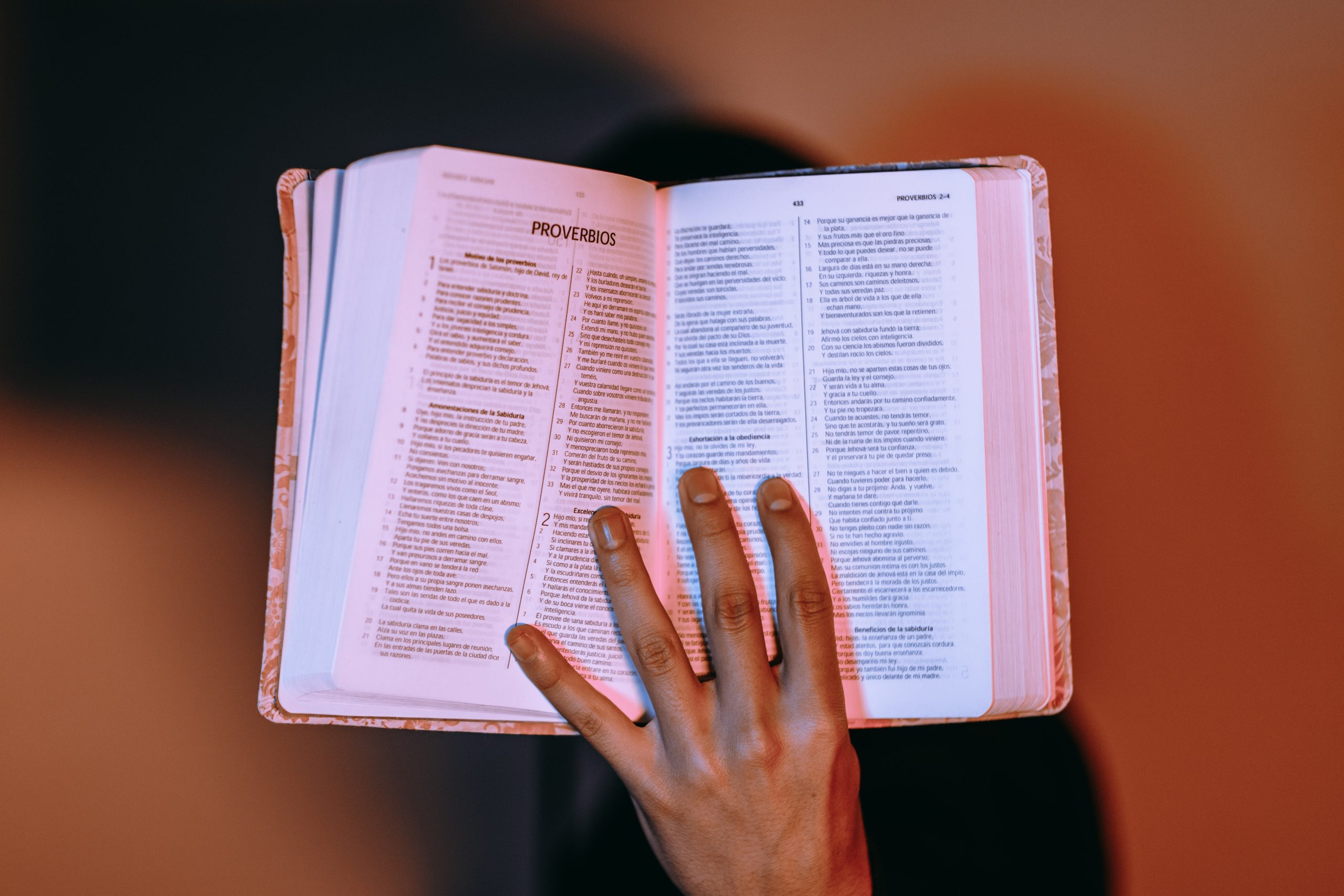
The Bible Changes Lives
The Bible has changed my life. That might sound dramatic, but it’s true. As a military wife with young children and living overseas, I found myself feeling lonely after the birth of my third son. I was floundering spiritually and didn’t have close Christian friends. After some serious prayer, the Lord led me to an inductive bible study and as I began to really “study” not just read the bible, not only did my joy return, but my life had a new purpose and meaning. I felt the Holy Spirit guiding me in a new way and my relationship with the Lord grew closer.
The last conclusion I would want any reader to come to is that I’m a super-spiritual Christian or that I didn’t have any major sin struggles after this “reformation” in my life. That fact is that I faced some of my hardest battles in the next couple of years. Seeking God isn’t something that anyone does naturally. I’ve felt for a long time that David knew something about my own heart when he wrote in Psalm 53:2-3, “God looks down from heaven on the children of man to see if there are any who understand, who seek after God. They have all fallen away; together they have become corrupt; there is none who does good, not even one.”
The Bible is a constant in the changing seasons of life and studying it has given me insight into God’s character. If you think about how you get to know someone who then becomes a good friend, it is by spending time with them, sharing, getting to know their habits, strengths, and weaknesses. You study them. The Bible gives us the opportunity to study God and spend time with Him. He speaks to us through His Word.
Verses I have memorized come to mind when I need peace and comfort. One of my favorite verses is Philippians 4:6-7 which says, “Do not be anxious about anything, but in every situation, by prayer and petition, with thanksgiving, present your requests to God. And the peace of God, which transcends all understanding, will guard your hearts and your minds in Christ Jesus.”
The good news is that God’s Word still has the power to change lives! It still comforts and guides, teaches, restores, and brings peace. I know that if you’re reading this, you have your own story to tell about the Bible’s impact on your life. Maybe God will bring someone across your path this week you can share your story with.
Deb Hill
Executive Assistant


It all Points to Jesus!
Years ago I had the privilege of teaching the Bible to Junior High students at a Christian School. The sixth-grade curriculum took the students from Genesis through Judges and the seventh grader's dove into the Gospels. I loved watching these young inquisitive minds read through Scripture, process the reality of sin and its impact, begin to recognize the longing hearts of humanity and identify their desperate need for a Savior. As each year progressed, a significant phrase continued to emerge: “It all points to Jesus!”
Throughout the Old Testament, we see the Israelites continue to fall into a cycle of sin and slavery. Sadly this was not a pattern that ended after they were rescued from Egypt; in fact, by the time we reach Judges, a common phrase was heard throughout the land, as is stated in Judges 21:25, “Everyone did what was right in his own eyes”. Over and over again, God’s people rebelled, sought their own selfish ways, thought they knew best, and ended up in sin. As the consequences of sin started to take their toll, they became captives, slaves to their own lustful desires. Eventually, this state of bondage would reach a point where they could no longer bear it, so God’s people would call out to Him in repentance, begging the Almighty to come to their rescue. They longed for a Savior.
It is with this longing that the promise of a coming Messiah began to imprint deeper on the hearts of the captives. Bible scholars have discovered over 300 prophecies declaring that this Savior would come, to forever set the captives free; and his name would be Jesus! Prophets throughout the Old Testament such as Daniel, Isaiah, Jeremiah, Hosea, and Micah, amongst others, all spoke of this coming king. Story after story and prophecy after prophecy point to the need for a Savior, Jesus.
Eventually, we arrive at the New Testament, and with this, the prophecies are fulfilled! Jesus does come to earth, he is born in a lowly state, he performs miracles, and he is rejected by his own people. Then with one final excruciating, selfless act of total love and devotion, he sacrifices his life for generations of people who have and will turn their backs on him. In this demonstration of grace and forgiveness, he forever conquers sin such that today, we who follow him can call out Isaiah’s words spoken by Paul, in 1 Corinthians 15:54-55, “When the perishable puts on the imperishable, and the mortal puts on immortality, then shall come to pass the saying that is written: ‘Death is swallowed up in victory. O death, where is your victory? O death, where is your sting?” Jesus is our freedom from captivity. Jesus is the message of the Bible. Jesus is our victory!
Lynette Fuson
Director of Care & Counseling


The Bible’s Historicity
Have you ever played a really, really good April Fool’s day joke on someone? I found the holiday enjoyable because I could make up a little story to have a little fun. One year I told my mother her friend had an emergency and to call her right away, so my mom called her, it was 6 am. Luckily her friend thought it was funny, phew! After a few years I realized around April 1st, people stopped believing me, so then if I had something serious I had to provide proof of authenticity. Fortunately, God has provided historical details and eyewitness accounts that allow us to believe the validity of Scripture and people don’t doubt like people doubted my stories around April Fool’s Day.
It is important that we see how God used historical events, woven with eyewitness testimony to create the historicity and legitimacy that is needed to prove the Bible true. Peter discusses how it is vital to acknowledge these are not made-up stories, but verifiable accounts (2 Pet. 1:16). If you were alive when the letters and Gospel accounts were written, then you could go and talk to the people that were the witnesses to hear what they saw. The details that Luke gives in his Gospel (Luke 3:1) and in Acts reveal how we can peel back the layers of history to see the timelines and people in charge so we know where to look to find not just the context, but how things actually fit together. Knowing the history behind the stories we love, gives validation and the truth we need to be confident.
Historical accuracy moves our hearts toward Jesus because he wants us to know that he is real, he wants us to trust in the relationship he has with us, and he wants us to be confident in the forgiveness only he can provide us. When the reality of God’s love becomes the perspective we see in Scripture then the history of Scripture helps to fix hearts and give new life to believers. Let me invite you to ask Jesus to help you see how the truth and accuracy of the Bible can help your heart this season. My prayer is that it helps build confidence in the Bible so your faith can grow and impact all those around you.
Pastor Jeremy Johnson
Family Pastor


The Bible’s Continuity
I loved reading books or watching movies and seeing from start to finish how the story unfolds. There might be a rabbit trail or a little part of the story that does not quite fit or ends abruptly, but overall the author or director seems to bring it to completion. Typically you follow one character through an aspect of their life or adventure. I loved Indiana Jones growing up and watching him go through trials and succeed through different parts of the world, fighting for others who needed help and doing what was right. What stood out was how each movie built upon the one before it to bring a big picture of the character's journey to life for me.
Maybe this is why the Bible has stood out in a spectacular way as well. It is God’s divine story about how the Father, Son, and Spirit work to create, redeem, and restore. However based on what we know, it should be choppy, misplaced, and hard to understand, BUT our God does something spectacular. To unite his story for us to know him and be made new by him he brings continuity that spans the width of his word.
God uses over 40 human authors to weave together a story of creation, fall, redemption, and restoration that becomes one amazing life-changing message. There is nothing else in the known world quite like it and God probably intended for that to be this way - it should stand out. The human authors came from different backgrounds, countries, spanned centuries, and wrote in three different languages (Hebrew, Aramaic, Koine Greek). God somehow took all of this to make one beautiful message that has changed the world.
The message of God creating and then saving his creation is a story that should be told in a miraculous way because it deserves more attention than Indiana Jones. The continuity of the Bible has marveled me since I was young and I hope it does the same for you. Next time you pick up your Bible, or look up Scripture on your phone, can you take a moment to thank God and remember how he has impacted you throughout your life through his story?
Pastor Jeremy Johnson
Family Pastor

The Bible – A Few Facts
The Bible is the best-selling book in history, with total sales exceeding five billion copies. The first Biblical stories were passed down orally and only written down later by various authors. Most Biblical scholars believe the Book of Genesis was the first book to be written down. This would have happened around 1450 BC to 1400 BC. So about 3400 years or so ago.
• The Bible is a library of 66 books, written by at least 40 Holy Spirit-inspired authors.
• The Bible has 17 historical books. ...
• The Bible has 5 poetical books. ...
• The Bible has 17 prophetic books. ...
• The Bible has 4 Gospels. ...
• The Bible has 21 Epistles
The Bible is the most-read book in the world. This best-selling book sees up to 100 million copies sold or donated annually. Approximately 20 million copies are sold each year in the U.S. alone. The Bible was written in three languages. Those languages are Hebrew, Aramaic, and Greek. Most of our Old Testament was written in Hebrew, which was the language the original readers spoke. Some of the Old Testament was written in Aramaic. There are about 58 English-language versions of the Bible. The Bible in its entirety has been translated into 704 languages and at least some portion has been translated into over 3,000 languages.
The longest book of the Bible is Jeremiah. He had a lot to say. He even wrote in the twentieth chapter of his book:
But if I say, I will not mention his word or speak any more in his name, his word is in my heart like a fire, a fire shut up in my bones. I am weary of holding it in; indeed, I cannot. (Jeremiah 20:9)
Jeremiah is the longest book based on how we currently arrange the books of the Bible. If we did it the old school way, the two-part book of Kings would be the longest book.
Kings wrote parts of the Bible. Half of the Psalms, a good chunk of Proverbs, and Ecclesiastes seem to be written by royalty. But other parts of the Bible are written by farmers, fishermen, a tentmaker, homeless prophets, a doctor, professional scribes, vocational musicians, pastors, etc.
There are at least 185 songs in the Bible. About 150 of these are in the book of Psalms. There are twenty-one dreams recorded in the Bible. The most used word in the Bible is "Lord," The last word is Amen.
The Bible has been around for a long time and has influenced people around the world. It’s interesting and fun to read these facts about our Bible, but more important is what is contained in the 1,189 chapters. We’re going to look at more of those details in the coming days.
Deb Hill
Executive Assistant

Posture of Pondering
Merry Christmas Eve Emmanuel Faith! The waiting is over. The culmination of Advent is here. Our Savior is born!
Over the last four weeks of Advent, we have experienced what it means to behold. We have beheld Jesus, the Lamb of God. We have considered surrender; relinquishing control of our own lives into the hands of the Almighty. We have beheld pursuit; a vision of what it looks like to run after this spotless lamb. We have beheld the Gospel; the Good News that Jesus Christ has come to take away the sins of the world! What an awesome promise!
This is amazing news, but what do we do with it? As you enter Christmas Eve, consider taking some time to ponder this precious gift. Luke 2:19 says, “But Mary treasured up all these things, pondering them in her heart.” Mary reverently unpacked each moment, held each word, longing, hope, and fear, and spread them out on the table of her heart; allowing the light of God’s presence to penetrate her soul and renew her joy.
The practice of pondering is a deeply spiritual act. It is setting aside anxieties, confusion, and fears and it invites us into a place of wonder, mystery, and awe. Pondering teaches us how to recognize the voice of God.
Before you rush into a busy day, choose one or two of the following and take some time to engage in the Practice of Pondering:
-
Set aside a specific time and place to reflect on how God has been present in your life.
-
Physically leave all distractions behind (including your cell phone!) Go for a walk in God’s amazing creation. Take some deep breaths. Look, smell, feel, notice.
-
Pray Scripture (try starting in the Psalms) back to the Lord inserting your own name into the text as a promise and a reminder of God’s care for you. As you reflect on his tender care, let this be a time of worship and adoration of your Lord.
-
Celebrate where you see God at work. Don’t rush past it but bask in the knowledge of his provision.
-
Confront or lament moments that you don’t understand. Be honest with God. He can handle it!
-
Ask God to give you eyes and a heart to see his goodness. Ask him to renew your faith and your trust in him.
Pondering allows us to feel the weight of God’s glory and fully celebrate the mystery of his ways. I hope you can find some time today to ponder this miraculous gift.
Lynette Fuson
Director of Care & Counseling
We hope you can join us this afternoon at 1pm, 3pm or 5pm for our Christmas Eve services as we gather together to worship Jesus and celebrate that our Savior has come!