


Kind God
Have you experienced a gap between what you know about God and what your feelings are telling you about Him? You might attest that “God is good”, but because of the current situation, you might not believe He is good to you. This happens when expectations aren’t met. We can feel let down, frustrated, and alone. This is how we first meet Naomi.
Naomi had a life planned out that included her husband, her two sons, and their offspring. In her imagination, she saw the blessing of God’s provision showing up for her through the men and the offspring they would produce. They would be the source of her life. The future she imagined it would be was ripped from her when all three of them passed away… as did her hope. She never imagined God would show His kindness to her in any other way, but she underestimated the love of God.
A vessel of God’s love for Naomi comes to her through the person of Ruth—her foreign daughter-in-law, now a childless widow too. In their time of grieving, Ruth stayed present with Naomi demonstrating a particular kind of love called “hesed.” In Hebrew, this love is difficult to describe without using multiple words of description. hesed is loyal, unfailing, loving-kindness, compassionate, strong, merciful, kind, steadfast, faithful, good, enduring, covenantal, gracious, and never-ending. All of those traits are true about God. What is also true is that we can pour out love for one another and be representatives of His love in tangible form. After all, from the beginning, God said, “It is not good for man to be alone” (Genesis 2:18). For Naomi, the loving (hesed) actions of Ruth to choose presence and faithfulness ended up being a source of hope. And ultimately, leading to the source of all of our hope…Jesus.
Who has loved you in a weary time? Thank God for His provision through them.
Is there a gap between what you know about God and what you experience? If so, how? After identifying a gap, tell God. He can handle it.
Lastly, read again the definition of hesed which describes God’s character. Use it to speak the truth to your soul. It’s my prayer for you this holiday season that this story left for us so that we might know Him more, helps to build confidence that we belong to a kind God… one that always has good for you. May what you learn of Him through experience exceed your expectations.
Jessica Klootwyk
Discipleship Director


Honest Naomi
Ruth 1: 1-22
I don’t know about you, but sometimes when someone asks how I’m doing–the standard answer is “Fine, thanks.” Not always the most honest answer. In Ruth, we see Naomi, her mother-in-law being very honest about how she feels after losing her husband and her sons! She is not only unhappy, but she is bitter against God, and depressed about her circumstances and the future. But she isn’t faking it, she is being very honest. She feels God has betrayed her.
The Book of Ruth is a beautiful example of how God can turn a hopeless situation into something glorious. The story begins in tragedy – famine and the death of Ruth and Naomi's husbands. But because Ruth is loyal and faithful, God rewards her.
In her grief, Ruth chose to stay with Naomi. We don't know what kind of family support systems Orpah and Ruth had with their respective families in Moab. Maybe Ruth chose to stay because she knew she could find more comfort with Naomi and they could heal together.
Though Orpah ultimately elected to stay behind, Ruth's love for Naomi compelled her to stay. She gladly gave up her family, homeland, and chance at a marriage to follow Naomi and serve God. When Ruth expressed her unconditional love for Naomi, she received unconditional love in return.
Naomi tried to push everyone away in her despairing state, but God wasn’t having it. He had a plan, and Naomi was part of it despite herself in the moment. Can you look back at a dark time and see how God was faithful even when you weren’t?
2 Timothy 2:13 says, if we are faithless, he remains faithful— for he cannot deny himself.
I truly believe God would rather we be honest about our feelings, even if they are bitter towards him than try to hide our true feelings and be dishonest. He knew her heart before it was devastated by loss and grief and He has empathy for those hurting. Most of all, he saw Ruth’s loyalty and faithfulness and in the process of rewarding her, Naomi benefitted also. His ways are always higher than our ways.
Deb Hill

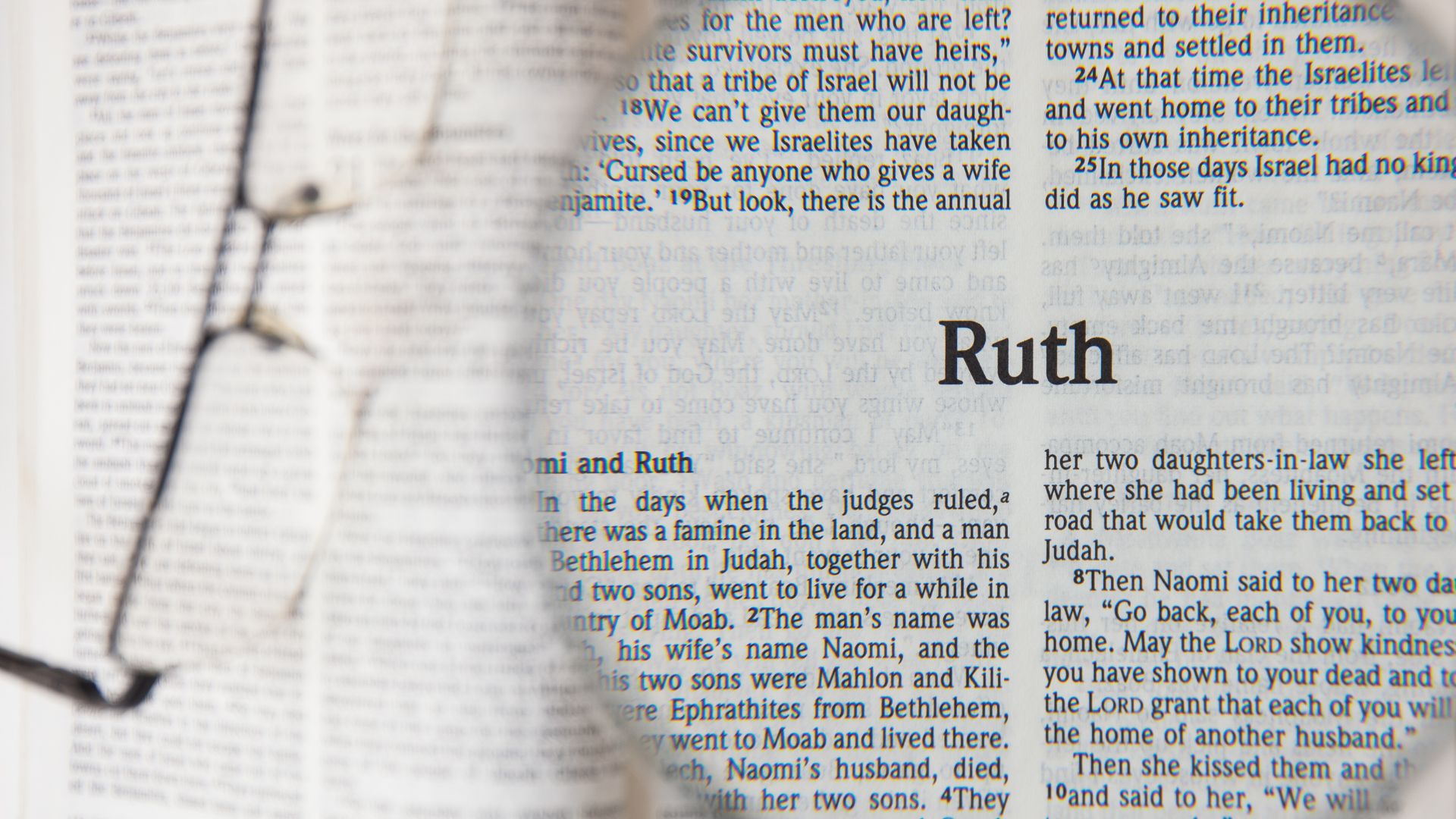
Be Like Ruth
In 1971, I was born to Don Robert Bundy and Betty Ruth Bundy. They named me Donielle Ruth, after my Dad (Don), and after my mother, whose middle name is Ruth. As a kid, I didn’t like my old-fashioned sounding middle name, but I’ve grown to appreciate its connection to Mom and a grandmother of Jesus-- shining women of strong faith.
Ruth was a standout, brave in difficult circumstances, she defied cultural norms. Listen to Ruth’s insistence with her mother-in-law Naomi. “But Ruth replied, “Don’t urge me to leave you or to turn back from you. Where you go I will go, and where you stay I will stay. Your people will be my people and your God my God. 17 Where you die I will die, and there I will be buried. May the Lord deal with me, be it ever so severely, if even death separates you and me.” 18 When Naomi realized that Ruth was determined to go with her, she stopped urging her.”
Ruth had reason to fear. She had lost her husband and was a foreigner; she surely lacked security and confidence about her future. And yet, she seemed to stare her fear down as she made a bold and beautiful promise to her widowed and devastated mother-in-law.
Words are cheap if insincere; if they are not followed up with action. Ruth promised Naomi that she wouldn’t leave her, that she’d always stay with her, even til death. So serious, she invoked the covenant name of Israel’s God—now her God too. Verse 18 says “Naomi realized Ruth was determined”. Her mind was made up.
In Matthew 21, Jesus tells a simple yet profound parable.
There was a man who had two sons. He went to the first and said, ‘Son, go and work today in the vineyard.’“‘I will not,’ he answered, but later he changed his mind and went. “Then the father went to the other son and said the same thing. He answered, ‘I will, sir,’ but he did not go.
“Which of the two did what his father wanted?”
“The first,” they answered.
Jesus said to them, “Truly I tell you, the tax collectors and the prostitutes are entering the kingdom of God ahead of you.
It matters more to God what we do than what we say. Words have power, but talk is cheap if our lives don’t match what we say we believe.
Ruth means what she says and says what she means. Though Ruth’s promise to Naomi is beautifully eloquent, what’s more admirable is that her walk matched her talk. Her character and integrity have been praised for centuries.
Be like Ruth.
Donielle Winter
EFCC Member


Advent Begins in the Dark
Isaiah 9:2
Advent is not the same season as Christmas. There, I said it! I know we want to celebrate Christmas; who wouldn’t? Christmas is built around lights and joy. It’s the time when we celebrate the coming of our Messiah. However, before the church celebrates Christmas, we celebrate Advent. Advent is a season of waiting—a time of longing for light in darkness. Flemming Rutledge captures this truth with the words, "Advent begins in the dark." These five words remind us that Advent isn't about rushing to the brightness of Christmas morning. It’s about sitting in the shadows, recognizing the brokenness of our world and our need for a Savior.
The prophet Isaiah captured the heartbeat of our collective longing when he wrote,
“The people walking in darkness have seen a great light; on those living in the land of deep darkness a light has dawned.” (Isaiah 9:2)
The people were walking in darkness, living under oppression, fear, and hopelessness. Their story is our story. Maybe you feel it in the ache of unmet dreams, the sting of loss, or the weight of injustice in our world. Darkness isn't just a metaphor; it's a reality that touches every human soul. That is the storyline of Advent, and it’s one we cannot fast forward through if we want to experience the joy of Christmas fully. Hope fulfilled is only joy-filled if we first enter the darkness.
We will get to Christmas, I promise. But, let’s first remember why we need Christmas; that is to say, why we need a Savior. The beauty of Advent is that it invites us to be honest about the darkness in our world and the darkness in our hearts. It doesn’t ask us to pretend or rush. It permits us to grieve, to hope, to cry out. The world isn't as it should be, but God is not distant. In Jesus, the light shines, and the darkness cannot overcome it (John 1:5).
Just as Isaiah declared good news, the promise of Advent is that light comes to us. We don't climb out of the darkness by sheer effort or positivity. Light breaks in—unexpected and unearned. This is the gospel of Advent: while we sit in the dark, the light of Christ comes near. As you enter this Advent season, pause in the dark. Reflect on where you’ve experienced loss or disillusionment. Bring those places before God. And then, with eyes of faith, look for the light. It may not always appear as expected, but it will come because God is faithful to His promises. Jesus, the light of the world, has come. He steps into our darkness to bring us hope, peace, and redemption. And one day, He will return to banish darkness forever. Until then, remember Advent begins in the dark.
Pastor Ryan Paulson


Put them into Practice
The Sermon on the Mount ends with the wise and foolish builders in Matt 7:24-27.
“Everyone then who hears these words of mine and does them will be like a wise man who built his house on the rock. And the rain fell, and the floods came, and the winds blew and beat on that house, but it did not fall, because it had been founded on the rock. And everyone who hears these words of mine and does not do them will be like a foolish man who built his house on the sand. And the rain fell, and the floods came, and the winds blew and beat against that house, and it fell, and great was the fall of it.”
To illustrate this passage with Junior High students, each Core Group is given a cardboard boxtop, popsicle sticks, paper, scotch tape, and fifteen minutes in their groups to build the best house they can. Half of the groups have sand filling the boxtop as a foundation and half have a slab of clay. After the allotted time, each group brings their house out to the courtyard in front of the JH room and sets them down below the walkway of the balcony above. From that upper floor, a hose with a powerful nozzle rains down water on each home. Typically, the sandy foundations get washed out and the clay foundations stand strong.
In Jesus’ story, both builders build a home and both experience a storm, the difference is in the principles they are built upon. Notice the important thing Jesus emphasizes: Hearing his words and then doing them!
Below is a quick summation of all the specific instructions Jesus gives from the Sermon on the Mount, Matthew chapters 5-7:
Chapter 5
Be glad when persecuted because of your great reward in heaven.
Let your light shine so people see your good deeds and praise God.
Practice and teach God’s commands to be called great in heaven.
Be reconciled to people before giving to the Lord.
Settle matters quickly with your adversary taking you to court.
Make drastic changes to deal with patterns of sin.
Stay true to your words and do what you say you will do.
Do not fight with evil people, serve them and share with them.
Love your enemies and pray for those that persecute you.
Chapter 6
Do good deeds in secret not to impress people.
Pray in secret not to impress people.
Pray like this (the Lord’s prayer).
Forgive others so you will be forgiven by God.
Fast in secret not to impress people.
Store up treasures in heaven, not earth.
Decide who you will live for, God or black Friday sales (oops- I mean money).
Do not worry about the things of life, God will provide.
Chapter 7
Don’t look down on others.
Acknowledge your faults.
Don’t serve or give to impress important people.
Ask God for good gifts.
Do to others as you would have them do to you.
Enter and walk the narrow gate and road that many are not treading, it leads to life.
Watch out for false prophets, their deeds will reveal their hearts.
Hear my words and do them.
This list leaves out some principles from the Sermon on the Mount, like the parts about anger and adultery. In those places he describes a consequence but doesn’t give a specific instruction. The list above is all of Jesus’ specific instructions from chapters 5-7. Trusting these principles makes a solid foundation. Solid enough to withstand the storms of life. Please don’t just read them, put them into practice!
Pastor John Riley


Four Awful Words
Have you ever been to an event that was ‘Invitation Only?’ One where you had to RSVP and show the invitation at the door? Having never been to one of those, I only know about them from movies or TV shows. Usually, it is someone dressed in their finest trying to gain entrance who does not have an invitation and whose name also does not appear on the guest list. The potential guest tries to get to see the host to affirm their relationship and thus join the event. In the theatrical presentation often the denial precedes other creative ways to gain entrance. It can be humorous or serious depending on the drama.
As we close the series on the Sermon on the Mount, we see Jesus talking about the event of entering the Kingdom of Heaven. Jesus had been teaching about what it takes to be righteous and to live the life God calls us to live. What He taught was challenging to the current thinking of the religious leaders; their ‘righteous’ acts were for themselves not for God. In verse 21 of Matthew 7, Jesus says, “Not everyone who says to me, ‘Lord, Lord,’ will enter the kingdom of heaven…” We are told in Hebrews that it is appointed unto man, ‘once to die and after that the judgment.’ So this event of entering the kingdom of heaven occurs at that time. Standing at the entrance, you have not responded to the invitation and your name is not written in the Lamb’s Book of Life (Revelation 21:27). You ask to plead your case to the Lord Jesus. “Lord, Lord, did we not prophesy in your name, and in your name drive out demons and perform many miracles?” vs 23. And then Jesus says the four most awful words, “I never knew you”!
I Never Knew You. Those must be the saddest four words ever.
For Jesus, it is all about having a personal relationship with those entering the kingdom of heaven. Everyone has an invitation but what was done with it? His sacrificial death and glorious resurrection are the basis of the invitation to the kingdom of heaven. Our repentance and trust in His righteousness is how we RSVP to become part of God’s forever family.
John 1:12 is one of my favorite verses, “Yet to all who received Him, to those who believed in His name, He gave the right to become children of God.” Do you remember the day you began this personal relationship with Him? Most of you reading or hearing this, probably do remember that day. Some of us have family or friends who may be depending on their own righteousness to enter the kingdom of heaven. I have one friend who said he did good things and was sincere so, of course, he would go to heaven. “I never knew you!” Some wanted to wait until they were ready and it became too late. “I never knew you!” Some just didn’t bother with the invitation or didn’t think it was real. “I never knew you!” This is not what God wants. 2 Peter 3:9 says ”…he is patient with you, not wanting anyone to perish, but everyone to come to repentance.” Titus 2:11 says, “For the grace of God has appeared that offers salvation to all people.”
Perhaps the LORD wants you to pray the names of those in your sphere to RSVP God’s invitation. Consider spending some quiet with Him to hear who He brings to your prayer thoughts! He might even give you the joy of explaining the invitation to them.
Francie Overstreet
EFCC Member


Fake Fruit
“Be wary of false preachers who smile a lot, dripping with practiced sincerity. Chances are they are out to rip you off in some way or other. Don’t be impressed with charisma; look for character. Who preachers are is the main thing, not what they say. A genuine leader will never exploit your emotions or your pocketbook. These diseased trees with their bad apples are going to be chopped down and burned.” Matthew 7:13:29 (The Msg)
We have a neighbor whose orange tree is usually over our fence and full of beautiful oranges that fall to the ground. Unfortunately, the tree isn’t deeply watered, or cared for properly so the fruit doesn’t taste good. The fruit looks good on the outside, but it isn’t sweet or juicy on the inside.
In the same way, we have always had false or fake preachers. You can identify false prophets or deceitful people by their actions and the results of their lives, often referred to as "fruits," just as you can tell a good tree from a bad one by the fruit it produces; good people will produce good deeds and positive outcomes, while bad people will produce negative consequences.
The first thing to notice about false prophets is that they may look like you. They may sound legitimate and they may even use all the right lingo. In other words, they know how to look the part. Many times, this is why they are so deceptive they make themselves appear to look like other sheep. They may look harmless, but they are extremely dangerous.
They may preach only what you and others want to hear. Wherever there is truth there will be error. Wherever people are teaching sound doctrine there will be people teaching false doctrine.
Satan’s greatest ambassadors are not pimps, politicians, or power brokers, but pastors. His priests do not peddle a different religion, but a deadly perversion of the true one. His troops do not make a full-out frontal assault but work as agents, sneaking into the opposing army. Satan’s tactics are studied, clever, predictable, and effective.
2 Timothy 2:15 says, “Do your best to present yourself to God as one approved, a worker who has no need to be ashamed, rightly handling the word of truth.” We can’t know the truth if we don’t study scripture, and ask the Holy Spirit for discernment to recognize fake fruit when we see it.
Deb Hill
Exec. Assistant

“Stay Off the Highway”
My parents are from Dallas. So I’ve traveled to Texas to visit family for as long as I can remember. Unlike southern California, the Dallas area, like most of the country, deals with this phenomenon called weather.
Dallas can experience snow and, more often, sleet or freezing rain in wintertime. In other seasons, they’ll have intense thunderstorms coupled with strong winds and scary large hail. As a kid, I recall adults discussing the weather, remarking, “Better stay off the roads!” or TV weathermen advising viewers to “steer clear of the highways” when weather conditions made driving unsafe and unwise.
Jesus gave his followers similar advice about road conditions in Matthew chapter 7. He says, “3Enter through the narrow gate. For wide is the gate and broad is the road that leads to destruction, and many enter through it. But small is the gate and narrow the road that leads to life, and only a few find it.” ESV translation adds that the road is easy which leads to destruction and the road is hard which leads to life.
These are some of the last words of Jesus’ famous Sermon on the Mount. At the beginning Jesus said, I want you to look different and live differently than the world around you—like a light in darkness, I want you to shine brightly, to live so righteously, that your life points other people, to me! If you’ve been paying attention, Jesus has taught us week after week about anger and forgiveness, faithfulness and adultery, honesty and integrity. He’s commanded us to be serious about sin, to love people when it’s not easy to love, and that Christ-followers live lives of generosity. We’ve learned not to worry or trust in wealth or earthly possessions. He’s taught us how to pray—humbly relying on Him and wanting his will more than my own.
Now he warns us. The choice ultimately is mine and yours to make. Which road will I choose? While the invite to follow Jesus is for everyone, the narrow road calling is hard. Most people will choose the easier route, the wider road with less hills, fewer challenges, it requires less effort. It’ll be tempting to choose that road. Anyone and everyone easily fit through the wide gate. … but be warned, it dead ends in destruction.
There’s a better option. It’s difficult, yes; it will require you daily to deny yourself. But it leads to Jesus and it promises life—life abundant, life to the full, life in the Spirit, everlasting life. Jesus came to abolish sin and death and destruction in every sense of the word.
Choose life today, choose to follow Jesus on the narrow way.
Donielle Winter
EFCC Member

Jesus and Everything Else
The American poet, Robert Frost, ended his famous poem The Road Not Taken, by writing,
Two roads diverged in a wood, and I—
I took the one less traveled by,
And that has made all the difference.
Those words have captured minds and hearts since they were written in 1915 as they evoke the imagery of a fork in the road, where we must decide which direction to walk. I think it stirs us because we know that it’s true - there are going to be watershed moments in our lives that we look back on that give definitive shape to the lives we live.
The move we made or didn’t make…
The job we took or didn’t take…
The school we decided to go to…
The proposal we decided to say “yes” or “no” to…
Life is the sum total of the decisions we make.
That’s what Jesus teaches in the Sermon on the Mount. He states there are two different paths, true and false prophets, and two kinds of foundations we can build our lives upon. The hearers of Jesus’ sermon have to decide what they’re going to do with his words. I’m struck by the fact that there are only two choices - Jesus and everything else. It’s here that as moderns, we often want to push back suggesting there has to be more than two choices. Isn’t life more nuanced than this binary Jesus presents? Does this sound too reductionistic to you? We live in a world that’s filled with options. You go to the grocery store and have 10 different kinds of spaghetti sauce to choose from. We’re often more comfortable with the idea that there are several good options. However, Jesus doesn’t leave us with that possibility.
Jesus is reinforcing his exclusive claim to be the way to life, a claim that he makes throughout the gospels. In John 14:6, Jesus said,
“I am the way, and the truth, and the life. No one comes to the Father except through me.”
Jesus doesn’t say it’s hard to get to the Father apart from him, he says it’s impossible. He doesn’t claim to be a way, he claims to be the way. He ends the Sermon on the Mount in the same way, forcing his hearers to decide what they are going to do with his words. Will they hear them and put them into practice or will they build their life on their own wisdom? Will they trust Jesus or will they trust their surrounding culture?
The same choice is in front of us. Two roads are diverging in the woods. The Jesus path is less traveled, but it’s the way to life and joy and peace. Choosing him makes all the difference here and now and throughout eternity.
Pastor Ryan Paulson

Ask, Seek, Knock
Just about everyone has heard of the Golden Rule. (They just might not know it comes from Scripture!) “Do to others what you would have them do to you” (Matthew 7:12). This encouragement is a timeless beauty and according to Jesus it also “sums up the Law and the prophets”—That’s quite a statement! Even though all of Mosaic Law and its writings could be summarized this way, the Cliff notes were not enough. The rule needed to be embodied by Jesus as He lived it out in the world for the disciples to see, experience, and eventually capture in the New Testament.
The disciples had varied backgrounds, convictions, and opinions, yet Jesus called them together to learn from Him and knit together with divine wisdom into a new kind of people. The way of the world is to think of and protect yourself at all costs, but the way of Jesus is to think of others and protect them as if they were your own being.
In their time with Jesus, the disciples witnessed a gentle and lowly way that included asking a lot of questions, seeking the heart matter, and opening doors of freedom and healing. Relationship doesn’t ever work when it’s forced… it can’t. So how can we model the way of Jesus in relationships—even when they are hard and disagreements threaten to divide? We can ask good questions without a critical judgemental heart. We can seek to understand a perspective and not immediately dismiss it. And finally, we can knock sensitively on areas (doors) of people's lives asking for permission to enter to provide wisdom and help. Afterall, isn’t this how you would want to be treated? The Kingdom of God makes its way into the everyday as the way of Jesus is lived out in all our relationships… wouldn’t that be golden?
Jessica Klootwyk
Discipleship Director