


And Grace Will Lead Me Home
“The grace of the Lord Jesus be with all. Amen.” Revelation 22:21
The phrase “And grace will lead me home” is in the fourth stanza of the song Amazing Grace. Written by John Newton in 1779, it was the declaration of God’s grace in saving him from the depths of sin and evil. He had become a sea captain in the evils of the slave trade, and God used a storm at sea to bring him to saving grace. Later, he became one of England’s most powerful evangelical preachers and an ardent foe of slavery. And Newton knew it was all about grace.
As we have completed the sermon series on Revelation, it is certainly fitting that the last sentence in the Bible focuses on grace. “The grace of the Lord Jesus be with all. Amen.” (Revelation 22:21) Grace has been the action of the love of God. When He created the world, it was grace. The Garden of Eden was grace. The plan of salvation was grace. “For by grace you have been saved through faith. And this is not your own doing; it is the gift of God.” (Ephesians 2:8) At the culmination of this part of the larger story, grace continues.
Grace has several definitions. Families may say “grace” before meals at the dinner table. We often describe someone’s movement as full of grace. But the grace of the Bible is something entirely different. It is the loving kindness of God toward undeserving mankind. We didn’t and don’t deserve grace. We have done nothing to merit it, and still God acts in grace toward us. Grace exists because of who He is, not because of what we have done. We live in a “quid quo pro” world, something for something. Not so with the grace of God, He has done it all. We are never meant to answer the question, “How can I repay Him for what He has done?”
Dear brothers and sisters, as you read through these three stanzas of the song Amazing Grace, ponder how God’s grace has led you to your true home with Him.
Amazing Grace (https://youtu.be/n3QbHNOxzcY)
Amazing grace! How sweet the sound that saved a wretch like me!
I once was lost but now am found, was blind but now I see.
’Twas Grace that taught my heart to fear, and grace my fears relieved;
How precious did that grace appear, the hour I first believed.
Through many dangers, toils and snares I have already come;
’Tis grace hath brought me safe thus far, and grace will lead me home.
Francie Overstreet
EFCC Member


Soonish
Let’s be honest: the word soon has a wide range of meanings. When my kids say they’ll clean their rooms “soon,” I know I could probably sit down and watch a show or two first. But when I hear the words, “Dinner will be ready soon,” it usually motivates me to wrap things up a little quicker. What do we do with Jesus’ words, “Surely I am coming soon,” from nearly 2,000 years ago?
John heard these words at the very end of Scripture, and Christians have been repeating them ever since: “Amen. Come, Lord Jesus!” This has been a prayer echoed throughout centuries of persecution, revival, boredom, faithfulness, failures, and successes. And still, Jesus hasn’t returned. So what are we supposed to do with a promise that feels delayed?
When I hear the word “soon,” I’m tempted to echo the words of Inigo Montoya, in The Princess Bride, who says, “I do not think that this word means what you think it means.” I don’t know… Maybe Jesus should have said that he was coming back soonish.
Or maybe we are the ones who misunderstand.
What Jesus is doing here is not giving us a countdown clock. He’s not circling a date on the calendar or telling us to start frantically tidying up the house at the last minute, like unexpected guests are pulling into the driveway. Notice the difference: Jesus doesn’t tell us to get ready. He tells us to be ready.
Those are not the same thing.
“Get ready” implies panic, scrambling, and pretending. It’s the idea that someday, when the timing feels clearer, we’ll finally clean up our act, take faith seriously, and follow Jesus wholeheartedly. “Be ready,” on the other hand, is about posture, not performance. It’s a settled way of living. A life already oriented toward trust, obedience, and love.
To be ready means we trust Jesus with our lives today. It means we forgive when it’s hard, love when it’s inconvenient, and remain faithful when the world feels impatient or cynical. Readiness isn’t about predicting His return; it’s about practicing His way. Loving God. Loving people. Walking humbly. Staying awake to what He’s doing all around us, right now.
In that sense, “soon” is always true. Jesus’ return is always closer than it’s ever been. And more importantly, our opportunity to live in His way, with His heart, is always now.
So we pray the ancient prayer with both hope and humor, honesty and trust: Amen. Come, Lord Jesus. Whether His return is soon, soonish, or far beyond our understanding of time, may He find us ready, not rushed; trusting, not pretending; but faithfully living in His way of love today.
Josh Rose
Family Pastor


Who Let The Dogs Out?
“I am the Alpha and the Omega, the first and the last, the beginning and the end.” Blessed are those who wash their robes, so that they may have the right to the tree of life and that they may enter the city by the gates. Outside are the dogs and sorcerers and the sexually immoral and murderers and idolaters, and everyone who loves and practices falsehood. (Revelation 22:13-15)
My family had a few pet dogs while I was growing up. For most of my childhood and adolescence, we had these two dogs, Max and Charlie. These dogs were fairly well-behaved, despite barking at anything that moved. We had gates inside our house and around our yard to help ensure they couldn’t go anywhere they weren’t supposed to. One day, we let the dogs into the yard, assuming that the gate was closed. After a while, I went out to check the yard and found the gate wide open and no dogs in sight. When we went to look for them, Max had found his way to the front door and he was just sitting there. Charlie, on the other hand, was running down the street. We eventually found him and brought him back.
The thing that I find most interesting about this passage is that, along with the idolaters and murderers, the dogs are outside the gate. Many of us who have had pet dogs might find this a little bit unsettling. When we imagine pet dogs, though, we miss the picture. I’ve been to several countries with lots of street dogs, and these are the ones I picture, desperate for scraps and only looking out for themselves. The thing about these street dogs, too, is that if you feed them, they will never leave you alone.
It’s possible that we’re talking about literal dogs — but the sentiment beneath that is what you feed sticks around. If you feed your sin, it doesn’t go away on its own. If you feed your addiction, it doesn’t go away on its own. If you don’t repent of it and release it, that sin will follow you around like a stray dog. However, if you feed self-control, discipline, and patience, these will also stick around and continue to grow.
I think that the dogs, along with the others mentioned here, let themselves out. We have the tendency to act a little bit like dogs. Yet, like my own dogs, while some of us may wander, others return home.
May we be people who return home.
Kassie Lowe
Young Adults Lead


Today Is Robe-washing Day!
Revelation 7:9, 14
…there before me was a great multitude that no one could count, from every nation, tribe, people and language, standing before the throne and in front of the Lamb. They were wearing white robes… And he said, “These are they who have come out of the great tribulation; they have washed their robes and made them white in the blood of the Lamb.”
Revelation 22:12, 14
“Behold, I am coming soon! My reward is with me, and I will give to everyone according to what he has done.” … Blessed are those who wash their robes, that they may have the right to the tree of life and may go through the gates into the city.
I’m encouraged and blessed by contemporary worship artists in recent decades; the music they’ve given us uniquely turns my heart toward God. But I admit, I’m also old school. I miss hymns.
I grew up singing hymns; many are deeply embedded in my thoughts and shaped my faith from an early age. As I read the Scriptures above, lyrics came to mind. In 1878, the year before Edison invented the light bulb, 40-year-old minister Elisha Hoffman wrote one of his 200 “worship songs.” I hope brother Hoffman’s words help you appreciate the “robes” in the verses above. It’s a metaphor of repentance… people realizing they are sinners, symbolized by unclean garments. They have found the way to salvation. The only way to cleanse themselves from sin and be made righteous in the eyes of God is to be washed in the redemptive, precious and power-filled blood of Jesus Christ, the Lamb.
Stanza 1:
Have you been to Jesus for the cleansing power?
Are you washed in the blood of the Lamb?
Are you fully trusting in His grace this hour? Are you washed in the blood of the Lamb?
Refrain:
Are you washed in the blood, in the soul-cleansing blood of the Lamb?
Are your garments spotless? Are they white as snow?
Are you washed in the blood of the Lamb?
Stanza 2:
Are you walking daily by the Savior's side? Are you washed in the blood of the Lamb?
Do you rest each moment in the Crucified? Are you washed in the blood of the Lamb?
Stanza 3:
When the Bridegroom cometh will your robes be white?
Are you washed in the blood of the Lamb?
Will your soul be ready for the mansions bright, and be washed in the blood of the Lamb?
Stanza 4:
Lay aside the garments that are stained with sin.
And be washed in the blood of the Lamb!
There’s a fountain flowing for the soul unclean. O be washed in the blood of the Lamb!
Donielle Winter
EFCC Member


A Sacred Place
“Then the angel showed me the river of the water of life, bright as crystal, flowing from the throne of God and of the Lamb through the middle of the street of the city; also, on either side of the river, the tree of life with its twelve kinds of fruit, yielding its fruit each month. The leaves of the tree were for the healing of the nations. No longer will there be anything accursed, but the throne of God and of the Lamb will be in it, and his servants will worship him.” (Revelation 22:1-3)
Growing up in different places in Oregon, I loved playing in the nearby forests and creeks. Climbing trees, building make-believe houses and forts, and playing in water are favorite memories. I still love trees, especially when the leaves turn, and the soothing sounds of creeks or rivers, and how they sparkle in the sun. Little pieces of heaven on earth.
The symbols in Revelation 22 of the river of life flowing from God’s throne and the tree of life with not only varieties of fruit but also healing leaves for the nations are reminders not only of God’s life-giving presence but also of provision and restoration. We saw the tree of life God planted in the middle of the Garden of Eden, which granted eternal life to humanity. After Adam and Eve disobeyed God by eating from the tree, God blocked their access to the Tree of Life and eternal life. This connection, the beginning and the end of the biblical story, shows what was lost in Eden and what is fully restored in God’s new creation through Jesus Christ, who embodies the source of everlasting life.
Some further study revealed this about the tree and river of life:
“Its leaves are for the purpose of giving continuous health to the nations. The river represents the Spirit of God and the tree represents the Word of God. These two, the Spirit and the Word, keep the nations in perfect health. The variety of the fruit and frequency of the fruit picture God’s full and constant satisfaction of man’s religious and moral hunger.” Gingrich, R. E. (2001). The Book of Revelation (p. 94). Riverside Printing.
There is so much to take in when we read and study Revelation 22, but we can be assured that “No longer will there be anything accursed, but the throne of God and of the Lamb will be in it, and his servants will worship him.” We will be in a sacred place of worship, where there is no need unmet, no lack of beauty or variety, no struggle, no pain and no need to seek refuge because we will be with the Source of peace, joy and strength, as He can be even now.
How exciting to imagine what it will be like for eternity with our heavenly Father!
Deb Hill
EFCC Member

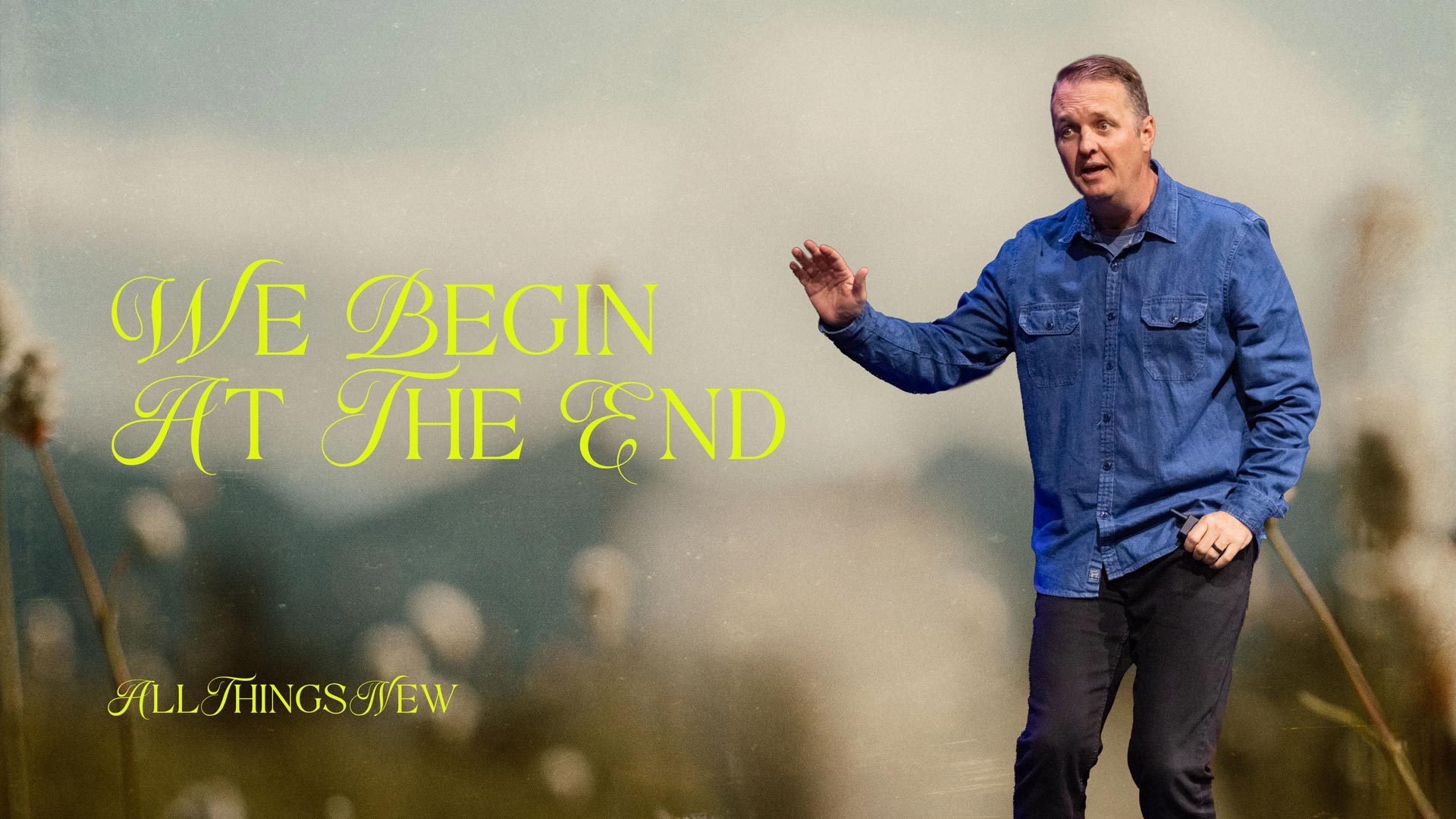
We Begin at the End
Series: ALL THINGS NEW: Revelation Season 5
Text: Revelation 22:1-21
Speaker: Ryan Paulson, Lead Pastor
January 18, 2026: On Sunday, Lead Pastor Ryan Paulson completed All Things New, Season 5 of our recent sermon series from the book of Revelation. This is the final section of the book and closes out our series in Revelation. Our sermon message is entitled “We Begin at the End.”


Glory Light
And the city has no need of sun or moon to shine on it, for the glory of God gives it light, and its lamp is the Lamb. By its light will the nations walk, and the kings of the earth will bring their glory into it, and its gates will never be shut by day—and there will be no night there. (Revelation 21:23-25)
John chooses his words carefully when describing the light source of this most epic city. He specifically says it’s the light of God’s glory. We’ve seen this before throughout Scripture: Moses on Mount Sinai, the Angel’s announcement to the shepherds, Jesus’ transfiguration, and Paul on the road to Damascus. The light for New Jerusalem will be a few orders of magnitude greater and apparently, permanent!
If we look more closely at recorded encounters with the light, we see it envelops or shines around people. Light doesn’t usually shine all around us; rather, it shines at us from a source. It seems like “glory light” works differently. If we believe God is omnipresent and, indeed, God is light, then light emanates from everywhere at once. Which means this light won’t cast shadows.
God’s light also changes us, like Moses was changed on Mount Sinai. His face shone after seeing his time with God, so much so that he wore a veil for a time. Imagine how brightly we will shine with perfect bodies. We are already called children of light. Indeed, our faith will be made sight. We shall shine the Lord’s light as well!
I personally don’t feel like I am any great light in the world these days. I actually often feel weary of all the battles we find ourselves in, sometimes brought on by our own follies. I long to be whole! I long for my new country, for my new city. I long for perfection and to behold unspoiled things. I long to love without the lingering specter of death promising loss of various descriptions. I long to worship full-heartedly, abandoning myself only to find myself completely in him. I long to know my Father and to do great things with him.
If I can achieve anything in these devotions, let it be to stir in you an eager anticipation for life eternal with Christ, our transcendent King and very best friend.
Jonathan Duncan
EFCC Member


Too Good for Words
And he carried me away in the Spirit to a great, high mountain, and showed me the holy city Jerusalem coming down out of heaven from God - Revelation 21:10
John’s vision of this new, holy city that unfolds in the following verses of Revelation 21 is quite literally beyond imagination! His description is radiant, massive, dazzling with light, precious stones, and streets of gold. He sees angels measuring translucent walls using golden measuring rods, twelve pearly gates and twelve bejeweled foundations each with a familiar name emblazoned on them, and measurements that are nothing short of astronomical. Clearly, John is seeing something that defies explanation, so he finds the best analogies that he can come up with in order to give us an image of this incredible vision.
However, whenever I read passages like this, I get caught up in the details, and I run the risk of focusing on the trees but missing the forest.
In his masterpiece, Mere Christianity, C.S. Lewis addresses this problem of interpreting Biblical imagery with his characteristic wit and poignancy. He says:
"There is no need to be worried by facetious people who try to make the Christian hope of ‘Heaven’ ridiculous by saying they do not want 'to spend eternity playing harps'. The answer to such people is that if they can't understand books written for grown-ups, they should not talk about them. All the scriptural imagery (harps, crowns, gold, etc.) is, of course, a merely symbolic attempt to express the inexpressible. Musical instruments are mentioned because for many people (not all) music is the thing known in the present life which most strongly suggests ecstasy and infinity. Crowns are mentioned to suggest the fact that those who are united with God in eternity share His splendor, power, and joy. Gold is mentioned to suggest the timelessness of Heaven (gold does not rust) and the preciousness of it. People who take these symbols literally might as well think that when Christ told us to be like doves, He meant that we were to lay eggs."
So rather than asking the kinds of questions John never meant to answer, “How wide are the walls?” or “How will we breathe in a city that towers into deep space?,” the better questions might be, “What kind of God builds a home like this?” or “If this is the best John’s words could describe, how much better will the real thing be?” Remember, interpreting these images symbolically does not make them less true; it allows them to be true in the way John intended.
When the words of Scripture stretch the limits of our language, then maybe there is a problem with our language, not a problem with Scripture. It is not that heaven is unclear, but that heaven is too good for words!
Josh Rose
Family Pastor

Big House
Then came one of the seven angels who had the seven bowls full of the seven last plagues and spoke to me, saying, “Come, I will show you the Bride, the wife of the Lamb.” And he carried me away in the Spirit to a great, high mountain, and showed me the holy city Jerusalem coming down out of heaven from God… He also measured its wall, 144 cubits by human measurement, which is also an angel's measurement.
Revelation 21:9-10,17
When I was growing up, most of my knowledge of heaven and new creation came from the 1993 CCM classic, “Big House.” This song describes the Father’s house as a place with many rooms, lots of food, and a yard big enough to play football. I can’t tell you if we’ll actually be playing football in new creation, but Audio Adrenaline did correctly state that the Father’s house is massive.
This passage tells us that the wall of the holy city is 144 cubits. Even more fascinating to me is the fact that John specifically writes that this is by both human and angel measurement. A cubit would be roughly the length from your elbow to your fingertips, so I’d argue that even all humans don’t share that exact measurement. Yet, we’re told here that the measurement is the same.
If I were to guess, I’d say that John is likely trying to tell us something more than just the measurement itself. This specific angel is said to have one of the seven bowls. He has a unique purpose and task. In the same way, humans made in God’s own image, have unique roles and tasks. This measurement is also 144, which is 12x12. In the Old Testament as well as the New, numbers were often symbolic or they conveyed a larger meaning. John is telling us something about new creation and ourselves.
As twelve is a number of completeness, I’d suggest that this is showing us that new creation is perfectly complete. This also tells us that we will be perfectly complete. Angels are glorified heavenly beings and fellow servants of God. This kind of equality that John is describing reinforces the fact that we too, will exist in glorified human bodies.
I pray that this promise of perfect completion in new creation would rest in your heart today.
Kassie Lowe
Young Adults Lead

Pure Light Prophecy Perfection
Revelation 21 describes an amazing city that God creates as a dwelling place with His chosen people. John sees a vision of the New Jerusalem coming down from a new heaven onto the new earth.
One amazing feature of this new city is the foundations of its outer wall. “The foundations of the wall of the city were adorned with every kind of jewel. The first was jasper, the second sapphire, the third agate, the fourth emerald, the fifth onyx, the sixth carnelian, the seventh chrysolite, the eighth beryl, the ninth topaz, the tenth chrysoprase, the eleventh jacinth, the twelfth amethyst” – Revelation 21:19.
I’m not really into jewels, but I do take longer to look at them than most of my family members when we are at the mineral and rock section of the Del Mar Fair or at rock museums. One thing that is unique and inspirational about the selections God makes in choosing these particular jewels is that they are all anisotropic. Isotropic means “having the same value when measured in different ways.” Anisotropic means having a different value when measured in different ways. The jewels God uses in building the foundation of the wall respond anisotropically when shown with light. Investigators have sliced very thin sections and shown double-polarized light through them. The result is that each of these jewels shines forth with a cacophony of colors when shown with pure light. Jewels that are isotropic: diamonds, rubies, and garnets, turn dark when shown with pure light. The foundations of the New Jerusalem’s wall will shine with amazing beauty as God’s pure light fills the place.
Pastor David Pawson, who explains this phenomenon in this YouTube video, https://www.youtube.com/watch?v=HFMrQUjp-Aw , believes that this feature of the new city gives evidence that the Bible is supernatural because this anisotropic feature of these gems was only recently discovered. “To me, that one thing alone would prove that the Bible was inspired by God because nobody could have known this. They didn’t know it until our generation, but there it is.” – David Pawson
Meditate today on the future home God is preparing for us, and walk in his light.
Dr. John Riley
Junior High Pastor
